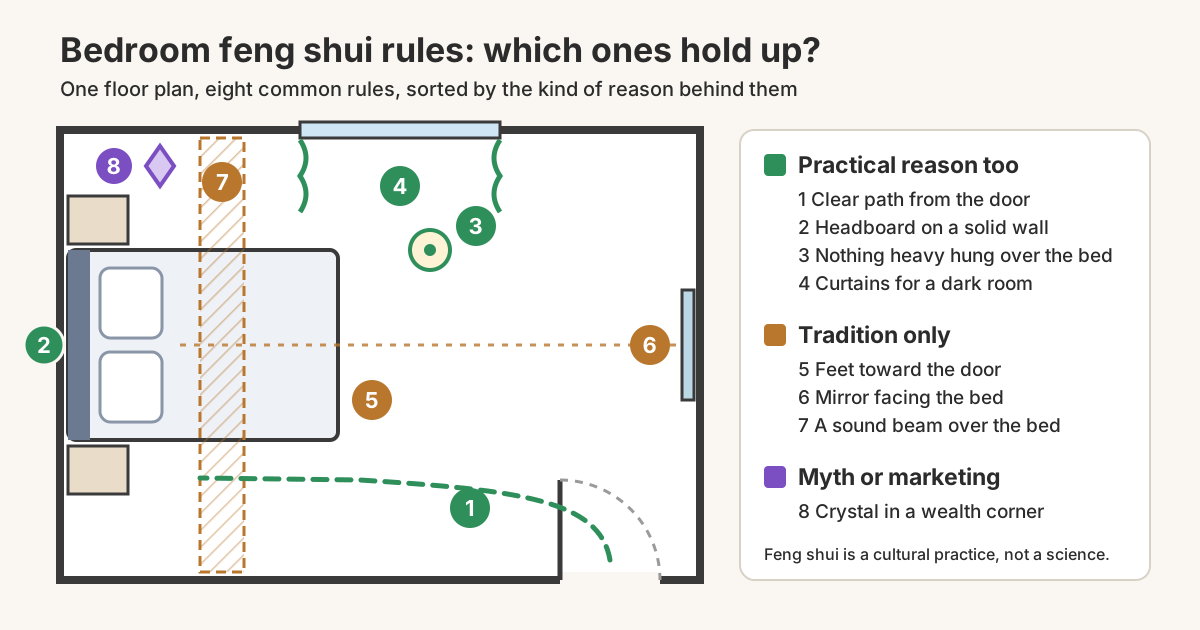
Eight common bedroom rules in one room. Green ones have a reason outside feng shui, amber ones are tradition, and purple is a product pitch.
Short answer: several feng shui bedroom rules have a practical twin in safety or sleep guidance: a clear path to the door, a headboard on a solid wall, nothing heavy over the bed, a dark room and a clear floor. Feet toward the door, a mirror facing the bed and a sound beam overhead are cultural preferences. Crystals and wealth corners are product claims with no evidence behind them.
How we sorted the rules
Our plain introduction to feng shui covers whether feng shui is real. In short, Wikipedia's feng shui article says it is generally regarded as non-scientific, with no empirical evidence that it works. We treat it as a cultural practice and don't promise luck, health, wealth or love from any layout.
This post is narrower. It takes rules from our feng shui bedroom rules checklist, plus a few popular extras, and asks of each one: is there a sleep, safety or health reason for it, what do named feng shui consultants say, and what does our planner do with it?
Each of the planner's 8 rules carries an evidence grade. A means several feng shui schools and sources agree, B means the rule comes from one school or a modern extension, and C means it is disputed or wasn't checked separately. These grades measure agreement among feng shui sources, not clinical evidence, as the methodology page also says.
The quick verdict table
| Rule | Practical reason | Feng shui tradition | Our planner |
|---|---|---|---|
| Clear path and door | Strong: fire and fall guidance | Qi enters freely | Practical check: routes, door swing |
| Headboard on a solid wall | Moderate: comfort | Support behind you | Rule, A, warning |
| Nothing heavy over the bed | Strong: falling objects | Pressure on the sleeper | Rule, A or B, warning |
| Dark room, screens away | Strong: sleep guidance | A yin room | Not checked |
| Clear under the bed | Some: dust | Stored items stall energy | Rule, C, note |
| No sharp corners at the bed | Minor: bumped shins | "Poison arrows" | Rule, A, note or warning |
| Feet not toward the door | Weak, unless it blocks the door | "Coffin position" | Rule, A, warning |
| Commanding position | Comfort, untested | See the door | Rule, A, warning |
| Bed not under a window | Mixed: drafts, blind cords | Weak support | Rule, A, warning |
| No mirror facing the bed | None, if securely hung | "Third person" | Rule, A or B, note |
| No beam over the bed | None, if sound | Pressure on the sleeper | Same rule as heavy fixtures |
| Anchor tall furniture | Strong: tip-overs | None | Not checked |
| Crystals, wealth corners | None | Modern additions | Not checked |
Rules with a solid practical twin
These are worth following even if you don't care about feng shui.
Keep the path to the door clear
Feng shui talks about energy entering through the door. The U.S. Fire Administration tells households to find two ways out of every room and to make sure doors and windows are not blocked. The CDC's fall-prevention advice says to get rid of things you could trip over.
How our planner judges it: as a practical check, not one of the 8 rules. It looks for a route from the door to each used side of the bed, 45 cm wide at minimum and 60 cm for comfort, and warns when a door swings into the space beside the bed. Our bedroom size guide shows which bed sizes leave that room.
Put the headboard against a solid wall
Tradition reads a solid wall behind the bed as support. The practical version is modest: a bed against a wall doesn't drift, and you get a backrest for reading. We haven't found sleep research that tests it, so we file it under comfort. Our guide to the feng shui headboard covers the details.
How our planner judges it: both ends of the headboard must sit within 20 cm of a wall, so an angled bed fails. Grade A, warning.
Don't hang anything heavy over the bed
Feng shui consultant Karen Rauch Carter told Livingetc it isn't helpful to have anything suspended above the bed, and practitioner Gary Hawkes told the same article he would avoid large lights there. Safety guidance agrees for a different reason. The Federal Alliance for Safe Homes (FLASH) says not to hang heavy objects over beds, sofas or anywhere you sit, and Ready.gov's earthquake page says to secure heavy items, including objects that hang on walls.
A structural beam is different. Tradition says it presses down on the sleeper, but if the beam is sound there is no practical reason to move the bed. That part is preference. A cracked or sagging beam is a job for a builder.
How our planner judges it: it flags a beam, pendant light or ceiling fan whose outline overlaps the bed in plan view, as a warning. Beams are grade A, pendants and fans grade B. It doesn't know height or mounting, and it treats a sound beam like a heavy lamp because the tradition does. Shelves and prints over the headboard are yours to check. Our post on the beam over the bed goes further.
Anchor tall furniture and TVs
This safety rule has no feng shui version. The CPSC's Anchor It campaign says to anchor furniture with drawers, doors or shelves, and TVs, to the wall to prevent tip-overs.
How our planner judges it: it doesn't check anchoring, so do it anyway.
Keep the room dark and the screens away
Tradition calls the bedroom a yin room, and feng shui consultant Anjie Cho writes about having enough yin energy and darkness where you sleep. Sleep guidance agrees. The NHLBI says to keep the bedroom quiet, cool and dark. Sleep Foundation explains that darkness triggers melatonin and light slows it, and suggests blackout curtains and less screen use in the two to three hours before bed.
A mindbodygreen guide by consultant Marianne Gordon goes further and says to remove all TVs, electronics and phones so they don't produce energy around you. The sleep reason is light and alertness, not energy, so a TV that stays off at night is fine. More in our guides to bedroom lighting and the TV in the bedroom.
How our planner judges it: it doesn't simulate light. A dark TV screen only counts as a reflection under the mirror rule.
Keep the floor under the bed clear
Livingetc's guide to under-bed storage says storing anything under the bed is generally frowned upon in feng shui, and Anjie Cho recommends nothing under the bed if at all possible. The practical case is smaller. The American Lung Association says most dust mite allergen exposure happens while sleeping, and lists reducing clutter among the ways to cut mites. Our bedroom clutter guide has storage ideas.
How our planner judges it: it reads the under-bed storage option you set for the bed. This is its only grade C rule, shown as a note.
Sharp corners aimed at the bed
Feng shui calls a corner that points at the bed a "poison arrow." The practical side is minor: a dresser corner is easy to walk into at night.
How our planner judges it: a corner of a desk, wardrobe, dresser, nightstand, built-in closet, fixed cabinet or column counts when it is 20 to 150 cm away and points at the bed with nothing in between. Nightstands beside the headboard are exempt. It is grade A, shown as a note, or a warning when the corner points at the head end.
Rules that are mostly tradition
These have little or no practical reason behind them. Follow them if you like the tradition, and don't worry if your room can't.
Feet toward the door, the "coffin position"
Anjie Cho describes the coffin position as lying in bed with your feet pointing out the door, and calls it energetically draining. The name links it to death and funerals. We couldn't find a historical source for where the idea started, so we treat the usual origin stories as folklore.
The practical twin is narrow. A bed that stops the door opening fully, or sits in the walking path, is a problem whichever way it faces, and the clear-path rule already covers that. We found nothing in sleep or safety guidance about which way your feet point. Our bed facing the door guide has options if you'd rather avoid it.
How our planner judges it: narrowly, as the foot of the bed directly facing the door. A bedroom or ensuite bathroom door counts when the whole opening lies beyond the foot of the bed and overlaps the bed's width, at any distance. A door off to the side doesn't count, and neither does a door marked as another type, such as a kitchen door. It is grade A, shown as a warning.
The commanding position
The commanding position means seeing the door from bed without lining up with it, with a solid wall behind you. Anjie Cho writes that having your back to the door raises stress levels. No sleep study we found tests that, so we treat it as a comfort preference. Our commanding position guide explains it with diagrams.
How our planner judges it: the headboard must be within 20 cm of a wall, a bedroom or bathroom door must lie in the half of the room the foot of the bed points toward, and the bed must not directly face it. A diagonal view isn't required. Grade A, warning.
Bed under a window
Tradition sees a window behind the head as weak support. Anjie Cho says it's best not to put the bed directly under a window, especially on the ground floor, though sometimes you have to. Drafts and early light are comfort issues that curtains mostly solve. For homes with young children there is a real safety point: the CPSC says to move cribs, beds and furniture away from windows and window covering cords, preferably to another wall. See our post on the bed under a window.
How our planner judges it: the rule fires when the headboard sits within 20 cm of a window wall and overlaps the window. Grade A, warning. It doesn't check blind cords.
A mirror facing the bed
A mindbodygreen guide by consultant Marianne Gordon repeats the belief that mirrors in front of the bed invite a third person into the marriage. We found no sleep or safety source saying a securely hung mirror across the room affects sleep. The safety issue is a heavy mirror over the bed, covered above. Our bedroom mirror guide lists ways to move, angle or cover one.
How our planner judges it: a mirror, vanity mirror, mirrored closet front or dark TV screen counts when the head of the bed is in its front view. There is no distance limit. Mirrors are grade A and TV screens grade B, shown as a note rather than a warning.
Bed direction by birth year
Compass schools use a Kua number, worked out from your birth year, to pick good directions for the bed. There is no practical twin here, and Wikipedia notes that people often get conflicting advice from different practitioners. Our planner's rules don't use compass directions; the Kua number calculator is a separate page outside the score.
Rules that are mostly marketing
Some bedroom advice comes with a shopping list. Wikipedia's feng shui article notes criticism that the practice has been commercialized, with one critic describing arrays of metaphysical products. Two examples come up again and again.
Crystals and crystal balls
Crystals turn up as remedies for many layout problems. Anjie Cho, for example, suggests hanging a feng shui crystal ball halfway between the bed and the door to adjust the coffin position. Wikipedia describes crystal healing as pseudoscience and notes that there is no evidence it works beyond a placebo effect. A crystal is fine as decoration, but it won't fix a bed that blocks a door.
Wealth corners, money frogs and money trees
The wealth corner is the part of a home said to govern money, and even its location is disputed. A House Digest guide puts it in the back left corner in the Black Hat (BTB) method, aligned with the front door, and in the east under the compass method. The same guide suggests amethyst, money plants and a three-toed money frog. Wikipedia lists BTB among modern Westernized methods not based on classical teachings. Our bedroom bagua map guide explains both systems. Nothing here has been shown to change anyone's income, and our planner doesn't check it. If you just like the plant, see our guide to plants in the bedroom.
Check your layout in the free planner
You can test most of the green and amber rules on a drawing before moving furniture. Draw your bedroom in the free planner as one room in 2D, with walls, doors, windows, furniture and fixed items like beams and pendant lights. It runs the 8 placement rules above plus separate practical checks for walking routes, door swing and drawers, which need at least 76 cm of clearance in front, or the pull-out depth plus 30 cm if that is more. You enter everything yourself; it doesn't read photos. It doesn't check light, anchoring, crystals or compass directions, and a pass is not a promise about sleep, health or anything else.
Sources and scope
The scientific status of feng shui, the criticism of its commercialization, conflicting advice between practitioners and the description of BTB come from Wikipedia's Feng shui article. The status of crystal healing comes from Wikipedia's Crystal healing article. Fire escape advice is from the U.S. Fire Administration's home fire escape plans page, and the trip-hazard advice from the CDC's fall prevention page. Overhead safety comes from FLASH's secure items that hang on walls and Ready.gov's earthquakes page, and the window cord advice from the CPSC's corded window coverings release. Tip-over advice is from the CPSC's Anchor It campaign. Sleep guidance comes from the NHLBI's healthy sleep habits and Sleep Foundation's light and sleep. Dust mite advice is from the American Lung Association's dust mites page. Karen Rauch Carter and Gary Hawkes are quoted in Livingetc's feng shui bedroom design mistake article, and the under-bed tradition is from Livingetc's what not to store under a bed. Anjie Cho's views come from her posts on the best feng shui bed position, why bed position matters and feng shui for better sleep. Marianne Gordon is quoted in mindbodygreen's feng shui for your bedroom. The wealth corner locations and objects come from House Digest's feng shui wealth corner guide. The planner details describe our own checks, explained on the methodology page. The headboard and sharp-corner points are everyday rules of thumb. We keep feng shui tradition, comfort and safety separate, and make no claims about luck, love, money, health or sleep.
Frequently Asked Questions
Which feng shui bedroom rules actually make sense?
The ones with a plain practical twin. Keep the path from the door clear and the door free to open, put the headboard against a solid wall, don't hang anything heavy over the bed, keep the room dark at night, and keep the floor under and around the bed clear. Fire safety, fall prevention, sleep and allergy guidance give their own reasons for these, with no feng shui involved.
Is sleeping with your feet toward the door bad luck?
There is no evidence that it affects luck or health. The "coffin position" is a feng shui tradition, and feng shui teacher Anjie Cho describes it as draining and vulnerable. The only practical issue is narrower: a bed that blocks the door from opening or sits in the walking path. If the door opens freely and you can walk past the bed, following the rule is a matter of taste.
Is a mirror facing the bed bad feng shui?
In feng shui tradition, yes. A mindbodygreen guide quotes the belief that a mirror in front of the bed invites a third person into the marriage. No sleep or safety body says a mirror across the room harms sleep. The practical rule is about weight, not reflection: the Federal Alliance for Safe Homes advises against hanging heavy objects over beds.
Do feng shui crystals or wealth corners work?
There is no scientific evidence that they do. Wikipedia describes crystal healing as pseudoscience, with no evidence of effects beyond placebo. Wealth-corner advice also disagrees with itself: one guide puts the corner at the back left of the home in the BTB method and in the east by compass. If you like a crystal or a plant, keep it as decoration, not as an investment.
What can your planner check, and what can't it?
The planner draws one bedroom in 2D. You enter the walls, doors, windows and furniture yourself. It runs 8 placement rules, such as the foot of the bed directly facing the door and a mirror facing the bed, plus separate practical checks for walking routes, door swing and a 76 cm clearance in front of drawers. It does not check lighting, furniture anchoring, beam height or structure, crystals, wealth corners or compass directions, and it does not read photos.