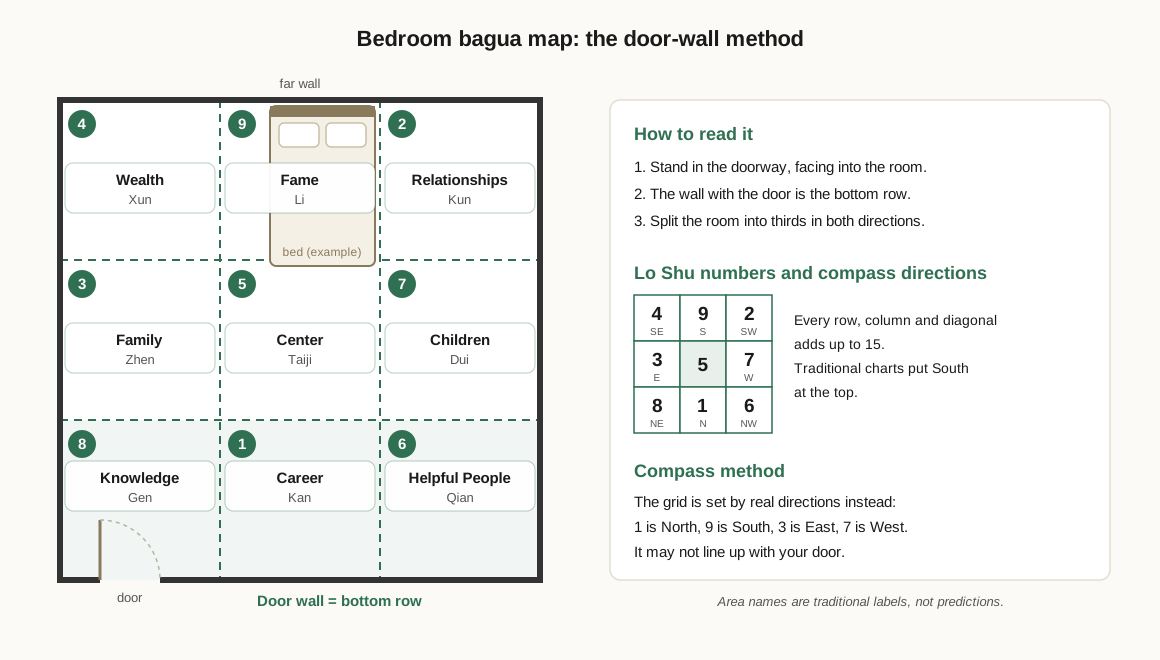
The door-wall method: stand in the doorway, and the wall with the door becomes the bottom row. The bed is only an example position; the numbers are the traditional Lo Shu square.
Short answer: a bedroom bagua map is a 3 by 3 grid laid over your bedroom floor plan. In the Western (BTB) method, the bottom row lines up with the wall that has the bedroom door. In the classical method, the grid is set by compass direction instead. Pick one method, use it consistently, and only read the grid after the bed is in a safe, workable spot.
What a bedroom bagua map is
The bagua is a traditional diagram of eight trigrams arranged around a center. On a floor plan it becomes a nine-part grid: eight outer areas plus the middle, each with a traditional name, a trigram and a number. Laying that grid over a single bedroom, rather than a whole home, is what people usually mean by a bedroom bagua map.
The grid is a cultural way of naming parts of a room. Area names such as Wealth or Relationships are traditional labels; they do not describe what will happen in your life, and nothing in this guide promises an outcome. If you want the eight trigrams themselves in more depth, our bagua map page explains each one, with its direction and five-phase association.
The nine areas and the bagua map numbers
When people search for "bagua map numbers", they usually mean the Lo Shu square: a traditional 3 by 3 arrangement of the numbers 1 to 9 in which every row, every column and both diagonals add up to 15. Each number sits in one area of the grid.
| Position (door-wall method) | Traditional name | Trigram | Lo Shu number | Classical direction |
|---|---|---|---|---|
| Far left | Wealth | Xun | 4 | Southeast |
| Far middle | Fame | Li | 9 | South |
| Far right | Relationships | Kun | 2 | Southwest |
| Middle left | Family | Zhen | 3 | East |
| Center | Center | (none) | 5 | Center |
| Middle right | Children | Dui | 7 | West |
| Near left | Knowledge | Gen | 8 | Northeast |
| Near middle | Career | Kan | 1 | North |
| Near right | Helpful People | Qian | 6 | Northwest |
"Far" means the wall opposite the door; "near" means the door wall. You will see slightly different names in different books, such as Love and Marriage for Relationships or Creativity for Children, but the positions and numbers stay the same. The center has no trigram; it is the point the other eight are arranged around.
Method 1: the door-wall (BTB) method
The door-wall method comes from BTB (Black Sect Tantric Buddhist) feng shui, a modern Western school associated with the teacher Lin Yun. It is the version behind most "btb bagua map" charts and most Western bedroom guides. It ignores the compass entirely.
- Draw the room. Sketch the bedroom as a rectangle, ideally to scale, with the door marked.
- Stand in the doorway, facing in. The wall you are standing in is the bottom row of the grid.
- Divide into thirds. Split the room into three equal parts from left to right and three from front to back.
- Name the cells. Bottom row, left to right: Knowledge, Career, Helpful People. Middle row: Family, Center, Children. Far row: Wealth, Fame, Relationships.
Because the bottom row always sits on the door wall, the bedroom door will fall in Knowledge, Career or Helpful People, depending on where it sits along that wall. If the door is cut across a corner, use the wall it mostly faces into.
The same steps give you a bagua map for each room, using that room's own door. A whole-home grid uses the front door instead, so the home grid and the bedroom grid rarely line up.
Method 2: the classical compass method
Classical schools set the grid by real compass directions, not by the door. You find the center of the floor plan, take a compass reading, and mark the eight directions from there. The north part of the room is the Kan area with the number 1, the south part is Li with 9, and so on, as in the right-hand column of the table above. Traditional diagrams draw south at the top, which is why the Lo Shu square is usually printed with 9 at the top.
Some practitioners use a nine-cell grid aligned to north; others draw eight 45-degree wedges from the center. In this approach the area labels matter less than the directions themselves, and the reading is often combined with other systems, such as the personal directions linked to a Kua number. Our guide to feng shui bed direction explains why those direction systems are personal and do not give one answer for everyone.
Which method should you use?
The two methods are different traditions, not a right and a wrong version of the same thing. They only agree when the bedroom door happens to sit on the north wall. In any other room they will put the same name in different corners.
Whichever one you choose, stay with it. The door-wall method needs no tools and matches most Western bedroom content. The compass method is what classical practitioners use and needs an accurate reading. Mixing them gives you a grid that belongs to neither tradition.
Reading the grid in a real bedroom
Start with the layout, not the grid. Before any area matters, the bed needs a workable position: a solid wall behind the head, the door in view without lining up with it, a clear path, and doors and drawers that open fully. These come from the commanding position and from everyday safety. The bagua is a layer you read afterward.
The areas people commonly look at. In Western practice, the far-right corner (Relationships) is the one most often discussed for a bedroom, because of its traditional name. People often keep it tidy and place things with personal meaning there: a pair of matching lamps, a favorite photo, or soft light. The center is usually kept open so the floor feels uncluttered. The Knowledge area near the door is a natural spot for a reading chair. These are personal decorating choices. They are not a way to bring about a relationship or any other result.
When the bed or a closet sits in an area
Most beds span two or three cells, and that is normal. In the diagram above, the bed sits in Fame and reaches just into the Center, because that is where the head can rest on a solid wall with the door in view. Nothing needs fixing. Moving a bed into a "better" area at the cost of a blocked route, a bed in line with the door or a window behind the head gets the priorities backwards.
A closet, wardrobe or dresser in an area is equally ordinary. A common traditional suggestion is to keep whatever sits in an area orderly, and to keep closet doors closed at night.
Irregular and L-shaped bedrooms: missing areas
Few bedrooms are perfect rectangles. For an L-shaped room, or one with a closet or en-suite cutting into a corner, draw the smallest rectangle that encloses the whole room and lay the grid over that. Any cell that falls outside the walls is traditionally called a missing area.
A common rule of thumb in Western practice is about proportion: if a part of the room juts out by less than half the length of that wall, it counts as an extension of the room rather than leaving a missing area. If the indent is more than half, the indented part is treated as missing.
Calling an area missing describes the shape of the room; it does not mean something is wrong with it. The usual responses are small: mark the inside corner with a floor lamp or plant, use a rug that suggests the full rectangle, or simply leave it. If you consider a mirror to "extend" a wall, check that it does not reflect the bed, as our guide to bedroom mirrors explains. For layout ideas that suit awkward shapes, the L-shaped example in our bedroom chart shows how to use the more regular part of the room for the bed.
Common mistakes to avoid
- Using the front door for a bedroom grid. For a single bedroom in the door-wall method, align to the bedroom's own door.
- Guessing the thirds. A rough sketch can shift a cell boundary by half a meter. Measure, or draw the room to scale.
- Letting the grid override safety. A bed squeezed into a named corner with a blocked path or a door that cannot open fully is a worse layout, whatever the corner is called.
- Treating area names as predictions. Wealth, Relationships and the rest are traditional labels. Decorating an area is a personal, symbolic choice, not a guarantee of anything.
Sources and scope
This guide describes the two common ways of applying the bagua to a room: the Western BTB door-wall method, which Wikipedia's overview of feng shui lists as a modern method not based on classical teachings, and the classical compass method built on the Later Heaven bagua. The numbers follow the traditional Lo Shu square. We present these as cultural traditions, keep tradition separate from everyday comfort and safety, and make no claims about luck, wealth, health or relationships for any area of the grid.
Draw your room before you draw the grid
A bagua grid is only as accurate as the floor plan under it. Draw your bedroom in the free planner with the real walls, door and window, settle the bed in a safe, comfortable position first, and then divide the plan into thirds to see which areas each piece of furniture falls in.
Frequently Asked Questions
How do I put a bagua map on my bedroom?
Draw the bedroom to scale, then divide it into a 3 by 3 grid of equal thirds. In the Western door-wall method, stand in the doorway facing in and line the bottom row up with the wall that holds the door. In the classical compass method, you take a compass reading from the middle of the room and place each area by its real direction instead.
What is the BTB bagua map?
BTB stands for Black Sect Tantric Buddhist feng shui, a modern Western school associated with the teacher Lin Yun. Its bagua map ignores the compass: the bottom row always sits on the entrance wall, so the door falls in Knowledge, Career or Helpful People. It is the version most Western bedroom guides use.
What do the numbers on a bagua map mean?
They are the Lo Shu numbers, a traditional 3 by 3 number square in which every row, column and diagonal adds up to 15. Each number belongs to one area and, in the classical method, one direction: 1 North, 9 South, 3 East, 7 West, with 5 in the center. They are reference labels, not scores.
Which corner of the bedroom is the relationship area?
In the door-wall method it is the far-right corner as you stand in the doorway looking in. In the compass method it is the southwest part of the room. Relationships is a traditional area name, not a promise; what people place there is a decorating choice with personal meaning.
What if my bedroom is L-shaped or has a missing corner?
Lay the grid over the full rectangle around the room. Any cell that falls outside the walls is traditionally called a missing area. A common rule of thumb treats a part that juts out by less than half of that wall as an extension instead. Many people simply mark the inside corner with a lamp, plant or rug, or leave it as it is.
Does the bed have to go in a particular bagua area?
No. Place the bed for safety and daily use first: a solid wall behind the head, the door in view, a clear route and a door that opens fully. A bed usually spans two or three areas anyway. The bagua is a cultural layer you read after the layout works, not a rule that overrides it.