Draw the facts before reading a result
A useful bedroom check needs more than a room label on a plan. Draw the actual walls in centimeters, locate the bedroom and ensuite bathroom doors, place windows on their wall segments, and set the bed position and direction. Add mirrors, a television, storage, overhead objects, and fixed features when they exist. The checker works from these editable objects, so a missing object cannot silently become part of the conclusion.
You can begin from a blank rectangular or irregular room. An existing floor plan image may be uploaded as a reference background, calibrated using a known length, and traced by hand. The site does not extract measurements or recognize furniture automatically. This distinction matters when the result is used to decide whether a door overlaps the bed or whether there is enough room to open a drawer.
Eight named placement checks
The checker registers eight feng shui rules: bed facing door, headboard against wall, bed under window, mirror facing bed, commanding position, clutter under bed, beam over bed, and poison arrow. Each rule runs only when its required objects are present. For example, a plan without a bed cannot receive a meaningful bed placement finding. These are explicit, repeatable geometry checks paired with traditional interpretation, not an image-only impression.
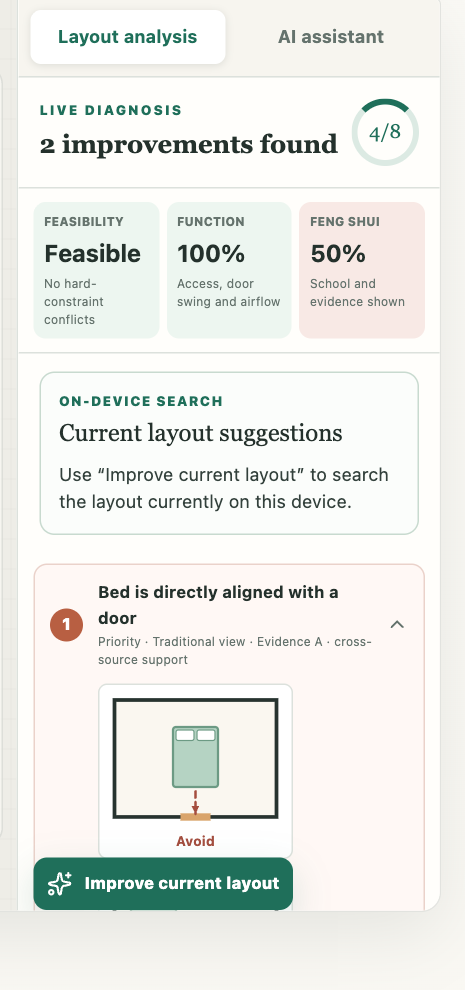
The bed-facing-door check considers a bedroom or ensuite bathroom door, not a kitchen door. A doorway must lie completely in front of the bed foot and overlap the projected bed width by a positive amount. It has no fixed maximum distance. The headboard check requires both ends of the headboard to be within 20 cm of the selected wall; a diagonal gap at one end matters.
Windows, reflections, position, and marked storage
For a bed-under-window finding, the headboard must point toward the wall carrying a window, be within 20 cm, and overlap the actual window segment along that wall. Reflective fronts include a mirror, certain mirrored furniture, and a dark television screen. The mirror check uses visible sample points 35 cm inward from the headboard, with a 20 cm width allowance; it has no distance cutoff that makes a far reflection automatically safe.
The commanding-position check asks for a supported headboard and a door in the front half-plane that is not directly in line with the bed foot. It does not require a diagonal room position or calculate sight blocked by furniture. Under-bed clutter uses the storage setting you mark on the bed. The tool cannot look under a physical bed or infer that setting from a picture.
Overhead shapes and sharp corners
A beam, hanging lamp, or ceiling fan is flagged when its two-dimensional footprint overlaps the bed with positive area. The rule does not measure installation height. A sharp corner finding is narrower than the idea that every furniture edge is harmful: designated convex corners on furniture or fixed obstacles must be 20–150 cm away, unobstructed, and point along their angle bisector toward the bed. A hit near the headboard is treated with particular care.
If an overhead object has a different real outline or a fixed cabinet is missing, adjust the drawing. A finding is only as good as the shapes and directions supplied by the person drawing the room; the checker is not a substitute for measuring the room on site.
Daily clearance is a separate result
Practical checks ask whether furniture can be placed and used in the available space. In particular, a drawer needs at least 76 cm of total clearance in front, or its opening depth plus 30 cm when that is greater. Door swing, access, and collisions also matter for an arrangement that works day to day. This layer is kept distinct from the eight traditional placement rules, so 76 cm does not become a ninth feng shui check.
From a finding to an alternative layout
After drawing, read the explanation next to a finding and inspect the relevant objects on the canvas. You may change an item manually and see the updated diagnosis after the edit, or explicitly ask the local search to seek an improved layout. When it finds a candidate, you can preview that candidate and apply it to the editable plan. Undo and Redo let you explore without treating the first proposal as final.
The search may fail to find a clear improvement for a cramped or highly constrained room. It reports that outcome instead of promising a universal answer. The checker also cannot evaluate every real-world factor: material, structural safety, lighting, and personal needs still require your own judgment. Neither a passing rule nor a suggested move promises health, financial, or relationship outcomes.
Checker questions
Does it check a whole house floor plan?
The current checker focuses on the bedroom you draw, its relevant openings, furniture, and fixed features. It is not a whole-house compass assessment.
Are there eight or nine feng shui rules?
There are eight registered placement rules. The 76 cm drawer clearance belongs to the separate practical-use checks.
Does a distant mirror stop being a finding?
No. The mirror-facing-bed rule has no distance cutoff; it checks whether a reflective front can face specified sample points near the headboard.
Will the checker move my bed automatically?
The plan stays under your control. You can edit it yourself or request a suggestion, preview any candidate, and choose whether to apply it.
Read the rules in context
Free drawing and checks need no account.
Check my bedroom plan