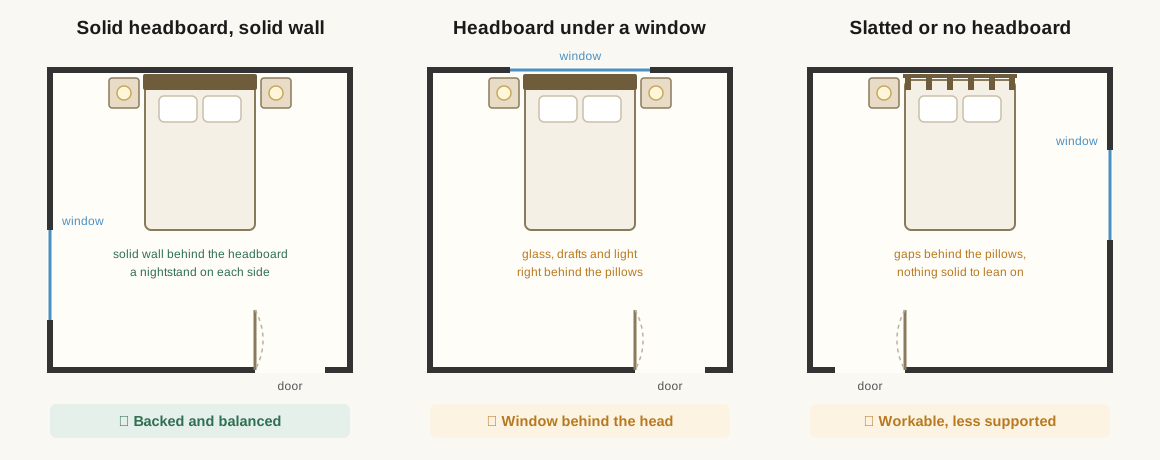
Same room size, three headboard setups. The first has a solid headboard on a solid wall and a nightstand on each side. The other two leave something open behind the pillows.
Short answer: feng shui prefers a solid headboard, made of wood or upholstery, set flat against a solid wall and not under a window. A nightstand on each side keeps the bed balanced. They should be similar in height and weight, but they do not have to match.
Why feng shui likes a solid headboard
Traditional bedroom feng shui describes the ideal bed as one with firm backing, the way a house sits well with a hill behind it. The headboard is the part of the bed that does that job. A solid panel between your head and the wall reads as support. It is the same thinking behind the commanding position, where you sleep with a wall behind you and a view of the door.
There are plain practical reasons too, and they are the ones you will notice every day:
- You get something to lean against when you read or drink coffee in bed.
- Pillows stay on the bed instead of sliding into the gap at the wall.
- A padded or wooden panel puts a layer between you and a cold exterior wall or a thin wall shared with a neighbor.
None of this means a bed without a headboard is wrong. A headboard is the easiest way to give the head of the bed a defined, solid edge, and that is most of what the tradition is asking for.
Headboard against a wall or a window
The headboard works best on a full, solid wall. Our planner checks exactly that: is the whole head edge flush against a wall, with no window or door behind it and no angled gap?
A headboard under a window is one of the most common questions, and people phrase it a few ways: against a window, in front of a window, under a window. The feng shui answer is the same for all three. A window behind the head is the opposite of backing, and in daily life it can mean drafts, morning light on your face, and cords or latches near the pillows. If another wall in the room can take the bed, that is the first choice.
When the window wall is the only workable spot, a tall solid headboard helps a lot, especially with heavy curtains you close at night. We cover the full set of options, with diagrams, in our guide to a bed under a window, so we will not repeat it here. If you do keep the bed there, leave room to reach the window latch and tie blind cords up out of reach.
Which direction should the headboard face?
"Feng shui headboard direction" usually refers to compass-school methods. Your birth year gives you a Kua number, which points to compass directions considered favorable for you, and the idea is to sleep with the top of your head toward one of them. Our guide to bed direction explains how that works and where it differs from placement rules.
Placement usually comes first. A headboard on a solid wall, with the door in view and the bed not directly in line with it, is the base. A favorable compass direction is a refinement for people who follow that school, and if it would put your headboard under a window, the common advice is to choose the solid wall. Our planner checks placement only. It does not read a compass or ask for your birth date.
Shapes and materials
Here feng shui guidance turns into traditional associations and personal taste. The common suggestions are:
- Solid wood or upholstered panels. Both look solid and are comfortable to lean on. That makes them the usual recommendation.
- Rounded or gently curved tops. These are often described as softer and calmer to look at than hard, pointed shapes.
- Fewer gaps. Slatted, spindled, or open-frame headboards leave gaps behind the pillows. Traditional guidance sees them as less supportive than a solid panel.
- No spikes or sharp points. Tall finials or spiky designs at head height are usually avoided. They also catch elbows and sleeves.
Some feng shui writing warns about metal headboards that look like bars. We would not worry about that. If you love a metal or slatted bed, a padded panel or a few large pillows behind you gives you a solid surface to lean on. These are preferences, and none of them will change your luck.
For height, aim for a headboard your shoulders can rest against when you sit up.
No headboard, or a floating bed
Platform beds and frames without headboards are common, and they can sit well in a feng shui bedroom. What matters more is where the bed goes. Push the head flat against a solid wall so there is no gap for pillows to fall into and no open space behind you. The basic rules for bed placement apply whether or not you have a headboard.
For the look without a full frame, a wall-mounted upholstered panel or a painted rectangle behind the bed marks the head of the bed. A bed pulled away from the wall in the middle of the room, with nothing behind it, is the setup feng shui likes least. A bench or low console behind it at least closes the gap.
Headboard on a bathroom wall
Many bedroom layouts put the bed against the wall shared with a bathroom, because that wall is often the longest solid one. Traditional guidance prefers another wall where possible. If the bathroom wall is the only option, a solid, well-padded headboard is one of the usual ways to soften it. Daily comfort matters more, though. Check that you do not hear the plumbing at night and that the wall is dry and free of mold. Our guide to a bed against a bathroom wall covers the rest.
Nightstands on both sides
Most feng shui and design advice suggests the same thing for nightstands: one on each side of the bed. The feng shui idea behind it is balance. For two people sharing a bed, a similar setup on each side means both get the same space, light, and somewhere to put their things.
Balance does not mean a matched set. Two nightstands of similar height and visual weight look balanced even if they are different pieces. Things that help in practice:
- A nightstand top close to the height of the mattress top is easy to reach from bed.
- A lamp on each side means each person can read or get up without turning on the overhead light. Wall-mounted sconces save surface space.
- Leave room to get in and out. Our planner looks for about 18 in (45 cm) of clear floor beside each side of the bed that someone uses. That is a layout rule of thumb, not a building code. Our bedroom size guide shows how this adds up for each mattress size.
- Keep the tops fairly clear. A cluttered nightstand right next to your head is the opposite of what the tradition is after. A drawer or small basket helps.
If a full nightstand will not fit on one side, a small wall shelf or a clip-on lamp gives that side a place for a phone and a light. Someone sleeping alone in a bed against a corner can get by with one nightstand.
Safety first
Feng shui is about how a room feels. Safety comes first:
- Fix a heavy or tall headboard to the bed frame or the wall as the maker directs, especially if it is freestanding.
- Avoid heavy shelves, framed art with glass, or mirrors right above the headboard unless they are securely anchored into studs. If you do hang something there, choose light pieces.
- Anchor tall dressers and bookcases to the wall, especially in homes with children. The US Consumer Product Safety Commission's Anchor It campaign explains how.
- Keep lamp cords and charger cables tidy and away from where your feet land when you get out of bed.
Common mistakes to avoid
- Leaving a gap between headboard and wall. An angled or pulled-out bed loses the backing the headboard is meant to give. Push it flat. Our feng shui bedroom rules list this alongside other placement checks.
- Buying a headboard to fix a bad wall. A headboard helps, but moving the bed to a solid wall usually does more.
- Expecting an outcome. A new headboard can make a bed more comfortable and the room feel more finished. It will not change your sleep, health, or relationships, and we do not claim it will.
Sources and scope
This guide reflects common Form-school bedroom guidance on backing the head of the bed, as described in Law of Feng Shui, and headboard-specific advice in LivingEtc and Ideal Home. Furniture anchoring advice comes from the US CPSC's Anchor It campaign. The 18 in (45 cm) bedside figure is our planner's own layout check, not a building or accessibility standard. We treat feng shui as a cultural tradition, keep comfort and safety separate from it, and make no claims about luck, love, money, health, or sleep.
Check your headboard wall in the planner
Before you buy a headboard, make sure the bed is on the right wall. Draw your bedroom in the free planner with your door and windows. It checks whether the head of the bed sits flush on a solid wall, away from the window and out of line with the door, and flags a bedside that is too tight to get in and out.
Frequently Asked Questions
Does feng shui say you need a headboard?
Feng shui traditionally prefers one. A solid headboard against a solid wall gives the head of the bed a sense of backing, the same idea as having a mountain behind you. It is a preference, not a requirement. A bed without a headboard pushed flat against a solid wall is still a reasonable setup.
Can a headboard go against a window?
Feng shui prefers a solid wall behind the headboard instead of a window. If the window wall is the only workable spot, a tall solid headboard and heavy curtains that close at night make the arrangement feel more backed. Keep the headboard clear of window latches and blind cords.
Which direction should a headboard face in feng shui?
Direction belongs to compass-school methods such as Kua numbers, which pick favorable bearings from your birth year. Form-school guidance cares more about placement: a solid wall behind the head, a view of the door, and not sitting directly in line with it. Our planner checks placement only, not compass direction.
What is the best headboard material for feng shui?
Solid wood and upholstered panels are the usual suggestions because they read as solid and are comfortable to lean on. Slatted, open, or sharply spiked designs are traditionally seen as less supportive. Treat this as taste and tradition. Pick something sturdy that you like looking at.
Do nightstands have to match in feng shui?
Feng shui likes balance on both sides of the bed, especially for two sleepers, but the pieces do not have to be identical. Two nightstands of similar height and visual weight, each with its own lamp, give the same balanced look. In a narrow room, a small shelf or wall-mounted lamp on one side can work.