Short answer: feng shui (風水, "wind and water") is a Chinese tradition for siting and arranging buildings, rooms and graves. It describes a space in terms of qi, yin and yang, the five elements and the bagua. It is Chinese, not Japanese. Its basic rules ask you to see the door, keep a solid wall behind you, clear the clutter and let in light and air. It is a cultural practice, and there is no scientific evidence that it changes luck or health.
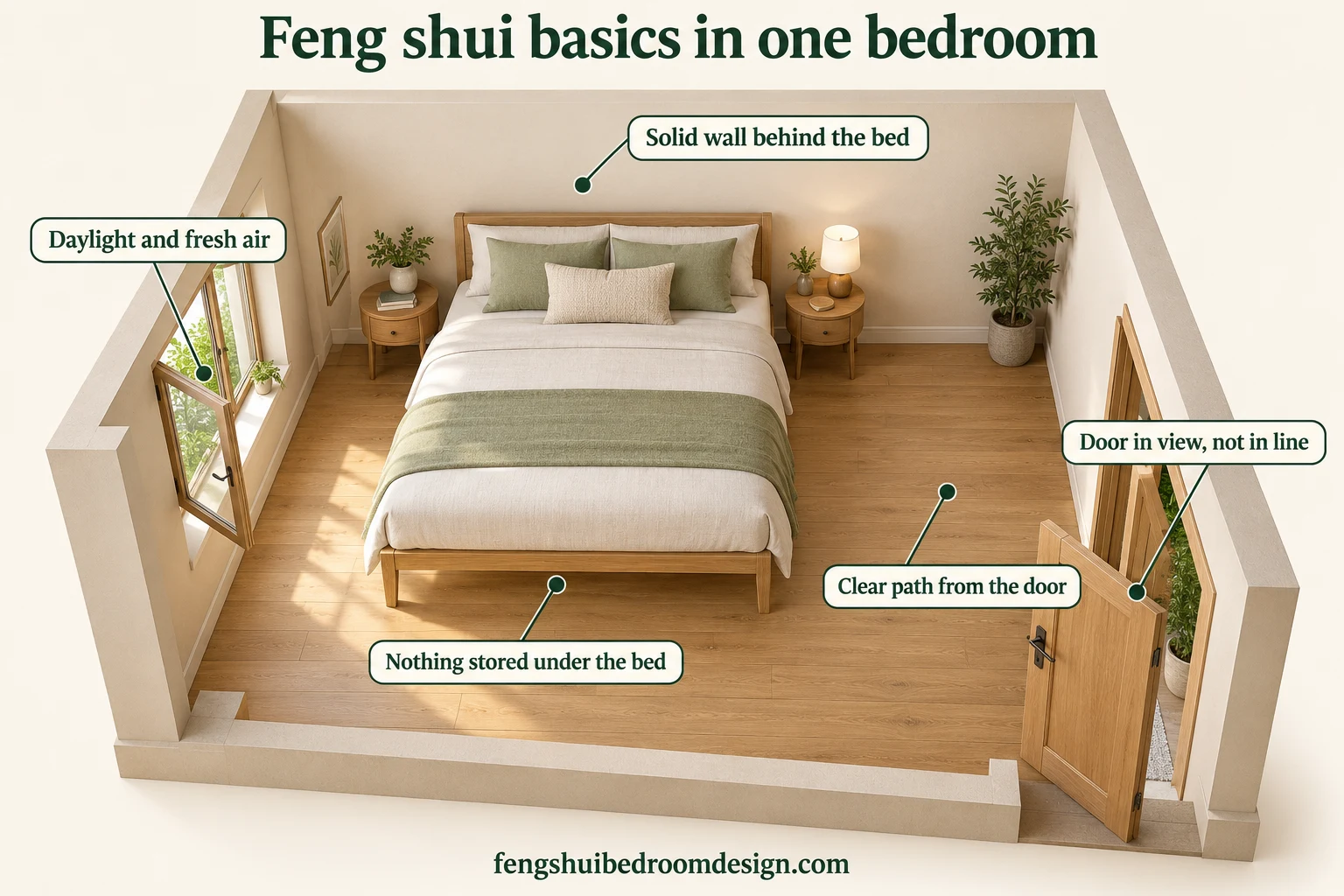
Five feng shui basics in one bedroom. Each has a traditional reason and, as the table below shows, often a practical one too.
What does feng shui mean?
Feng shui is written 風水 in traditional Chinese. 風 (feng) means wind and 水 (shui) means water. In Mandarin it sounds roughly like "fung shway."
The name is usually traced to the Book of Burial, a text attributed to Guo Pu, a writer of the Jin dynasty. A line in it says that qi scatters when it rides the wind and stops when it meets water. So wind and water were not just scenery. They were the forces thought to carry qi across a landscape and to hold it in place.
In practice, feng shui is a set of ideas about where to put things. It started with choosing sites for graves and buildings and later moved indoors to rooms and furniture. When people say a room has "good feng shui," they usually mean it feels calm, open and easy to move through.
Is feng shui Chinese or Japanese?
Feng shui is Chinese. Wikipedia traces its earliest roots to Neolithic sites in what is now China, including those of the Yangshao and Hongshan cultures. Its classic texts are Chinese too.
The practice did travel. A 2015 paper in The Review of Korean Studies describes geomancy as an ancient Chinese art that reached Korea in an early wave of cultural diffusion from China. In Korean it is called pungsu. Japanese reads the same characters as fūsui, and Vietnamese has phong thủy. Each place developed its own habits, but the tradition started in China.
A short history of feng shui
The details are debated, so here is only what the general references say.
- Early practice was tied to astronomy. Wikipedia notes that some techniques go back to Neolithic China and others were added later, especially in the Han, Tang, Song and Ming periods.
- From at least the Han dynasty, court officials assessed sites for palaces, capital cities and imperial tombs.
- The oldest branch, the Form branch, was first concerned with tombs ("yin houses") and later with homes and other buildings ("yang houses").
- The magnetic compass was used for feng shui from its invention. Practitioners use a detailed compass called the luopan.
- Feng shui was suppressed in mainland China in the Mao era and became popular again after the reforms that followed.
- The New World Encyclopedia ties its Western popularity to the years after President Nixon's 1972 visit to China, and says the teacher Thomas Lin Yun developed Black Sect (BTB) feng shui in the United States in the early 1980s.
The core ideas in plain words
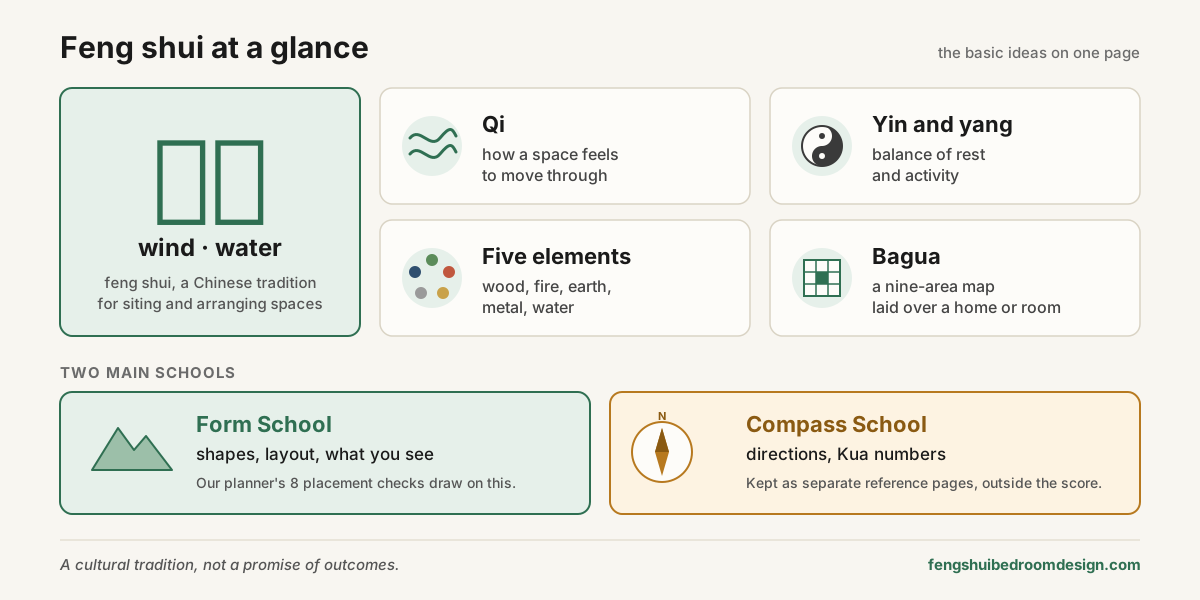
The basic vocabulary of feng shui on one page. The sections below take each piece in turn.
You will meet the same handful of words in almost every feng shui guide. Here is what they mean in everyday terms.
Qi
Qi is usually translated as energy or life force. In feng shui it describes how something moves through a space. A useful plain reading is "how a room feels to walk through." Long straight corridors are said to rush qi, cramped corners trap it, and a room with clear paths lets it move gently. You don't have to believe in qi to notice that a room you can cross without dodging furniture feels better than one you can't.
Yin and yang
Yin and yang are two complementary sides of everything: quiet and active, dark and light, soft and hard. Feng shui uses them to talk about balance. A bedroom leans yin because it is a room for rest, so the usual advice is softer light and fewer loud colors. A kitchen or living room can carry more yang.
The five elements
The five elements are wood, fire, earth, metal and water. They come from the Chinese idea of wu xing, five phases that feed and check each other in two cycles. Feng shui uses them as a vocabulary for colors, shapes and materials. Our five elements chart lists the usual pairings and explains both cycles.
The bagua
The bagua is a map of eight areas around a center, laid over a home or room as a 3 by 3 grid of nine areas. Each area is linked to a part of life, such as career or family. Classical practice sets the grid by compass direction. The Western BTB method sets it from the entrance wall instead. Our bedroom bagua map guide shows both methods.
The commanding position
The commanding position is the spot in a room where you can see the door without sitting directly in line with it, with a solid wall behind you. It applies to the bed, the desk and the stove. You will find this advice in most beginner guides, which makes it one of the most widely shared feng shui basics. Our commanding position guide walks through it with diagrams.
The two main schools: Form and Compass
Traditional feng shui has two broad schools. Most modern practitioners mix them, but it helps to know which advice comes from where.
The Form School is the older one. It reads the shape of the land and the shape of a room: hills behind, open space in front, water nearby, and indoors the walls, doors, windows and furniture. Its advice is about what you can see. A solid wall behind the bed, a view of the door and no beam overhead are all Form School ideas.
The Compass School works with directions. Practitioners take a compass reading of the building and use systems such as Eight Mansions and Flying Stars. A common beginner version is the Kua number, a personal number worked out from your birth year that gives a set of favorable directions. Our guide to feng shui bed direction explains how the Kua system is used for beds.
Then there are modern Western variants. Wikipedia lists BTB (Black Sect Tantric Buddhist) feng shui among Westernized or modern methods not based on classical teachings. BTB is the source of the bagua map that lines up with your front door and ignores the compass, which is the version most Western magazines show.
Basic feng shui guidelines and why they exist
According to feng shui, these are the guidelines that matter most in a home. For each one, the table gives the traditional reason and, where an honest one exists, a plain practical reason.
| Guideline | Traditional reason | Practical reason |
|---|---|---|
| See the door from your bed or desk, without lining up with it | The commanding position: you face what comes in | You notice who enters without turning around |
| Keep a solid wall behind your head | Support behind you, like a hill behind a house | A headboard on a wall is steadier and less drafty than one under a window |
| Keep the entry and paths clear | The door is where qi enters, so it should not be blocked | Clutter and loose rugs are easy to trip over, especially at night |
| Declutter, including under the bed | Stuck objects are said to stall qi | Less to clean, less dust, easier to find things |
| Keep mirrors from facing the bed | A mirror is said to bounce energy around a room meant for rest | A reflection moving in the dark can startle you |
| Soften sharp corners near the bed or chair | Corners pointing at you are called "poison arrows" | Fewer bruised shins at night |
| Let in light and air | Fresh air and daylight keep qi from going stale | The EPA notes that bringing in outdoor air helps indoor air quality |
Some feng shui rules have no practical twin. A bed under a beam has no real downside if the beam is sound, and the tradition still advises against it. Those rules are cultural preferences, and it is fine to treat them that way. For the full list for bedrooms, see our feng shui bedroom rules checklist.
Is feng shui real?
It depends on what "real" means. Feng shui is a real tradition. Imperial officials in China used it to choose sites for palaces and tombs, and many families still consult it when they build, buy or rearrange a home.
Is feng shui for real in the sense of changing your fortune? There is no good evidence for that. Wikipedia sums up the position: scientists and philosophers have identified feng shui as non-scientific, and there is no empirical evidence that it works. Wikipedia's article on qi describes qi itself as a pseudoscientific concept. Different practitioners can also give conflicting advice about the same home.
The useful part is the overlap. Several feng shui basics line up with ordinary comfort and safety: clear paths, a stable spot for the bed, enough light and fresh air, and fewer things to trip over. Those are worth doing whether or not you care about qi. We'd suggest treating the rest as a cultural way of looking at a room. Enjoy it if it speaks to you, and don't spend money or worry on promises of luck, wealth, love or health.
How we use feng shui on this site
Our free planner is a 2D tool. You draw your bedroom to scale, place the door, windows and furniture, and the planner runs 8 placement guidelines taken from Form School advice:
- Headboard against a solid wall.
- Commanding position (the door in view from the bed).
- The foot of the bed not pointing straight at the door.
- Bed not under a window.
- No mirror or dark TV screen facing the bed.
- No beam over the bed.
- No sharp corners pointing at the bed.
- No clutter under the bed.
Room fit and everyday use are checked separately. Those checks look at things like walking space and room to open drawers, so a layout can follow tradition and still be flagged as cramped, or the other way around. The planner doesn't read photos or floor plans for you, and it makes no promises about sleep, health or anything else. Compass tools such as the Kua number calculator and the Bagua map are separate reference pages, and they don't affect the score. The methodology page explains every check.
Feng shui basics in five steps
If you want to start somewhere, start with the floor plan, not decorations.
- Clear the path from the door to the bed and around it.
- Put the bed or desk against a solid wall where you can see the door without lining up with it.
- Check what the bed faces. Move or cover mirrors and screens that reflect it.
- Look up and around for beams, heavy fixtures and sharp corners close to where you sleep.
- Open the window, add a lamp you like, and only then think about colors, elements or the bagua.
To check steps 2 to 4 on a measured drawing, try the free bedroom planner.
Sources and scope
The meaning, history, schools and scientific status come from Wikipedia's Feng shui article, which also lists BTB as a modern Western method, and its article on qi. The Book of Burial line and the dating of Black Sect feng shui come from the New World Encyclopedia entry on feng shui. The spread to Korea is from the abstract of "The Introduction of a Formal Garden as a Sign of the Diffusion of Geomancy (P'ungsu) to the Korean Peninsula," The Review of Korean Studies, 2015. The air note is from the EPA's page on improving indoor air quality. We present feng shui as a cultural tradition. We keep it separate from everyday comfort and safety, and we make no claims about luck, wealth, love, health, sleep or productivity.
Frequently Asked Questions
What is feng shui in simple terms?
Feng shui is a Chinese tradition about where to place buildings, rooms, graves and furniture, and how to arrange them. Its ideas include qi (a flow through a space), yin and yang, the five elements and the bagua map. In a home, most of the basic advice is about layout: a solid wall behind the bed or desk, a view of the door, clear paths and an uncluttered room.
What does feng shui mean?
Feng shui (風水) means "wind" and "water". The name is usually traced to a line in the Book of Burial, a text attributed to the Jin dynasty writer Guo Pu, which says that qi riding the wind stops at the boundary of water. Wind and water stand for the natural forces that shape a site.
Is feng shui Chinese or Japanese?
Feng shui is Chinese. The earliest evidence for it comes from Neolithic cultures in what is now China, and its classic texts are Chinese. The practice later reached Korea, where it is called pungsu, and Japanese has its own reading of the same characters, fūsui. Whatever the local name, the tradition began in China.
Is feng shui real?
Feng shui is a real cultural practice with a long history, but there is no scientific evidence that arranging a room changes luck, wealth, love or health. Scientists and philosophers generally classify it as non-scientific. Some of its basic advice, like keeping paths clear and letting in light and air, overlaps with ordinary comfort and safety, and that part is worth following for its own sake.
What are the basic rules of feng shui?
The most common feng shui guidelines for a home are: see the door from your bed or desk without lining up with it, keep a solid wall behind your head, keep the entry and paths clear, declutter, keep mirrors from facing the bed, soften sharp corners near where you sit or sleep, and let in light and fresh air. Each has a traditional reason, and most also have a plain practical one.