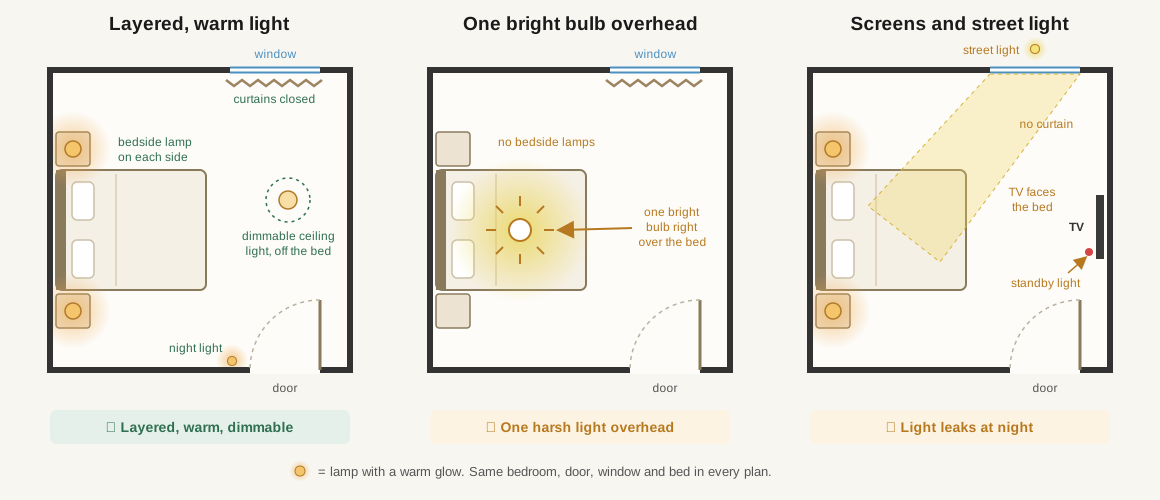
One bedroom, one door, one window. Only the lights change. On the left the light comes from several soft sources, none of them over the bed.
Short answer: feng shui tradition wants bedroom light soft and layered, because it treats the bedroom as a room for rest. Put a lamp on each side of the bed, keep the main ceiling light on a dimmer and off the space right above the bed, and close curtains at night. Sleep guidance agrees on the practical part: keep lights dim and warm before bed, sleep in a dark room, and get bright light in the morning.
What feng shui says about bedroom light
Feng shui is a Chinese tradition about how rooms and buildings are arranged. We treat it as a cultural practice, not a science. Our plain introduction to feng shui covers the background.
Lighting has fewer rules than bed placement. Most of the ideas that do come up start from yin and yang. In that pairing, yin goes with dark, quiet and rest, and yang with light and activity. Feng shui writers usually call the bedroom a yin room, so the advice leans toward softer light.
- Feng shui expert Karen Rauch Carter told Livingetc that the bedroom is for yin quiet time and that very bright light or a harsh light color is not recommended there.
- Feng shui consultant Anjie Cho suggests warmer-toned light in the bedroom and more darkness at night. She also links the cool blue light of phones to yang energy.
- A pair of similar lamps on two nightstands is a common tradition. A mindbodygreen guide by consultant Marianne Gordon lists two similar lamps among the things to set out in pairs.
That is most of it. Tradition asks for a balance of light and dark, with more dark at night, and you don't need special products to follow it.
What sleep guidance says about light
Sleep science has its own reasons for similar advice, and they don't depend on feng shui at all. We keep the two apart here.
Light affects melatonin. Sleep Foundation explains that the brain starts making melatonin in response to darkness, and that light slows or stops it. Harvard Health adds that even dim light can affect the body clock, and that blue light at night has a stronger effect than other colors.
From that, the main sources give similar advice:
- Dim the lights before bed. Sleep Foundation suggests keeping lights dim as you get ready for bed and notes that low, warm light may help with relaxation.
- Sleep in the dark. Sleep Foundation says it is best to sleep in as much darkness as possible, because eyelids don't block enough light. The NHLBI says to keep the bedroom quiet, cool and dark, with a dim night light if needed.
- Put screens away. The CDC suggests turning off electronic devices at least 30 minutes before bed. Harvard Health and Sleep Foundation both suggest avoiding bright screens for two to three hours before bed.
- Get bright light during the day. Harvard Health recommends plenty of bright light in the daytime, and Sleep Foundation lists morning sunlight as a healthy habit.
None of this promises a better night. It is what the guidance recommends, and it happens to fit the feng shui preference for a calm, darker bedroom.
Warm vs cool light: reading the bulb box
Light color on a bulb is listed as color temperature, in kelvins (K). ENERGY STAR's bulb guide puts it simply: a lower K means warmer, yellowish light, and a higher K means cooler, bluer light. The same guide places bulbs sold as "soft white" and "warm white" at the warm end and "daylight" at the cool end. It also tells you to judge brightness by lumens, not watts.
For a bedroom, that gives a simple rule. Use warm bulbs in the lamps you use at night. If you want cooler light for dressing or cleaning in the morning, put it in a different fixture, so the evening lamps stay warm.
Layer the light: ambient, task and accent
One ceiling bulb as the only light is the setup most bedroom lighting advice, feng shui or not, tries to avoid. It lights the whole room at once, at one brightness, from straight above. Layers give you choices instead:
- Ambient light is the general light for moving around. It might be a ceiling fixture, a floor lamp or wall sconces.
- Task light is for reading and other close work, usually bedside lamps.
- Accent light is a small lamp on a dresser or a low light on a shelf. It is soft light for the evening.
Put the ambient light on a dimmer if you can. A dimmer lets the same fixture be bright for cleaning and low for winding down. If you swap in LED bulbs, check that the package says dimmable before putting them on a dimmer switch. ENERGY STAR notes that dimmable certified bulbs exist and says to check the packaging for proper use.
Bedside lamps: one on each side
Bedside lamps do most of the work at night. A few practical points:
- One lamp on each side of the bed, so each sleeper controls their own light. This also matches the feng shui tradition of a pair.
- The bottom of the shade at about shoulder height when you sit up in bed, so the bulb isn't in your eyes. Wall-mounted swing-arm lamps work well when nightstands are small.
- A switch you can reach without getting up. An inline cord switch, a touch base or a smart plug all do the job.
- A fabric or paper shade that spreads the light instead of a bare bulb.
The lamps sit beside the headboard, so where the bed goes decides where they go. Our guide to the feng shui headboard covers placing the bed against a solid wall first.
Overhead lights and the bed
Feng shui has a separate tradition about anything heavy hanging over the bed. Feng shui practitioner Gary Hawkes told Livingetc he would avoid large lights over the bed, partly because you don't want to look straight into a light as you lie down. Our post on the beam over the bed covers beams, pendants, chandeliers and ceiling fans, so we won't repeat it here.
The short version is to put the main ceiling light over the open floor rather than over the mattress. If the fixture is already fixed in place, use it on low or leave it off at night and rely on lamps. Heavy fixtures need proper mounting either way.
Windows, daylight and blackout curtains
Windows are the biggest light source in most bedrooms, by day and sometimes at night. Street lights, car headlights and early summer sunrise all come through glass.
- At night, Sleep Foundation notes that blackout curtains block most outside light. Curtains or blinds that close fully, plus a liner if needed, cover most street light. A close-fitting sleep mask is another option the same source mentions.
- In the morning, open the curtains and let daylight in. Bright morning light is part of the same sleep guidance.
Feng shui also has opinions about the bed's position relative to a window. Our post on the bed under a window explains that tradition and the curtain-based fixes.
Screens and standby lights
Phones, tablets, TVs and chargers add light you might not notice: the glow of a screen, a blue charging LED or a red standby dot.
- Charge your phone across the room or face down, and turn on its night mode in the evening if you use it in bed.
- Cover small LED lights on chargers and power strips with a piece of tape or move them out of sight.
- If the TV stays in the bedroom, use the sleep timer so it doesn't run all night. Sleep Foundation suggests the same.
Feng shui adds a separate idea: a dark screen facing the bed acts like a mirror. Our guide to the TV in the bedroom covers that tradition and the simple fixes, such as a cabinet or a cloth cover.
Night lights for walking at night
A dark room and a safe path to the door can both happen. The NHLBI says a dim night light is fine if you need one. Sleep Foundation suggests a dim, warm-colored night light placed away from the bed, or a motion-activated light that gives low light only when you get up. Harvard Health recommends dim red light for night lights, since red light has less effect on melatonin.
Put the night light low, near the floor along the route to the door or bathroom, not at eye level by the pillow. For older adults, the CDC's fall-prevention advice includes making sure the home has plenty of light, and a lamp you can reach from bed helps with that too.
Light color vs wall color
Light color and paint color work together. A warm bulb makes walls look warmer, and a cool bulb can make soft colors look gray or flat. Test paint samples under your actual bedside lamps at night as well as in daylight. Our guide to feng shui bedroom colors covers restful palettes and the five-element color labels.
Bedroom lighting checklist
- At least two light sources besides the ceiling light, usually a lamp on each side of the bed.
- Warm bulbs in the lamps you use at night, and brightness checked in lumens.
- The main ceiling light on a dimmer, and not hanging right over the bed.
- Bedside lamp switches reachable from bed, with shades that keep the bulb out of your eyes.
- Curtains, blinds or blackout liners that close fully at night and open in the morning.
- Phones charged away from the pillow, standby LEDs covered, and the TV on a sleep timer.
- A dim, low night light or motion light along the path to the door or bathroom, if you need one.
Plan the room before you buy lamps
Lamps follow the furniture, so it helps to settle the layout first. Our planner lets you draw your bedroom in the free planner as one room in 2D, with its doors and windows, the bed and 12 furniture types: bed, desk, wardrobe, nightstand, dresser, mirror, TV, chair, bookshelf, sofa, storage trunk and vanity. You can also add fixed items such as a pendant light. It checks clearances, door swing and 8 bedroom placement rules, including no beam, pendant light or ceiling fan over the bed and no bed under a window. You draw the room yourself; it doesn't read photos or floor plans. It also doesn't simulate light, brightness or color, so use the checklist above for the lighting itself.
Sources and scope
Karen Rauch Carter and Gary Hawkes are quoted in Livingetc's feng shui bedroom design mistake article. The points on warm light, darkness and blue light come from Anjie Cho's feng shui for better sleep, and the pair of lamps from mindbodygreen's feng shui for your bedroom. Yin and yang as dark and light follow Wikipedia's yin and yang article. Sleep guidance comes from Sleep Foundation's light and sleep page, Harvard Health's blue light has a dark side, the NHLBI's healthy sleep habits and the CDC's about sleep page. Bulb color and brightness come from ENERGY STAR's light bulb purchasing guide, and the home lighting point for older adults from the CDC's fall prevention page. Lamp height and switch placement are everyday rules of thumb. We keep feng shui tradition, sleep guidance, comfort and safety separate, and make no claims about luck, love, health, mood or sleep.
Frequently Asked Questions
What is the best lighting for a feng shui bedroom?
Feng shui tradition treats the bedroom as a yin room for rest, so it prefers soft light from several sources over one bright fixture. In practice that means a lamp on each side of the bed, a ceiling light on a dimmer that does not hang over the bed, and curtains you can close at night. Sleep guidance points the same way for its own reasons: dim light before bed and a dark room while you sleep.
Is warm or cool light better for a bedroom?
For the evening, warm light. Sleep Foundation says low light and warm color temperature may help with relaxation, and Harvard Health notes that blue light at night suppresses melatonin more strongly than other light. On a bulb box, a lower Kelvin number means warmer, yellower light. Cool white light can still be useful for daytime tasks like dressing or cleaning.
Is it OK to sleep with a light on?
Sleep guidance generally says to sleep in as dark a room as you can. The NHLBI says to keep the bedroom dark, with a dim night light if you need one. If you want a light for getting up at night, Sleep Foundation suggests a dim, warm night light placed away from the bed, or a motion-activated one that only comes on when you move.
Do bedside lamps have to match in feng shui?
No rule says they must be identical. A pair of similar lamps on matching nightstands is a common feng shui tradition, tied to balance and to the idea of a bedroom set up for two. Two lamps that are close in height and style follow the same idea. The practical part matters more: one lamp each side, at reading height, with a switch you can reach from bed.
Can your planner show how my bedroom lighting will look?
No. The planner draws one room in 2D with doors, windows, the bed and other furniture, plus fixed items such as a pendant light. It checks clearances, door swing and 8 placement rules, including no pendant light or ceiling fan over the bed and no bed under a window. It does not simulate light, brightness or color.