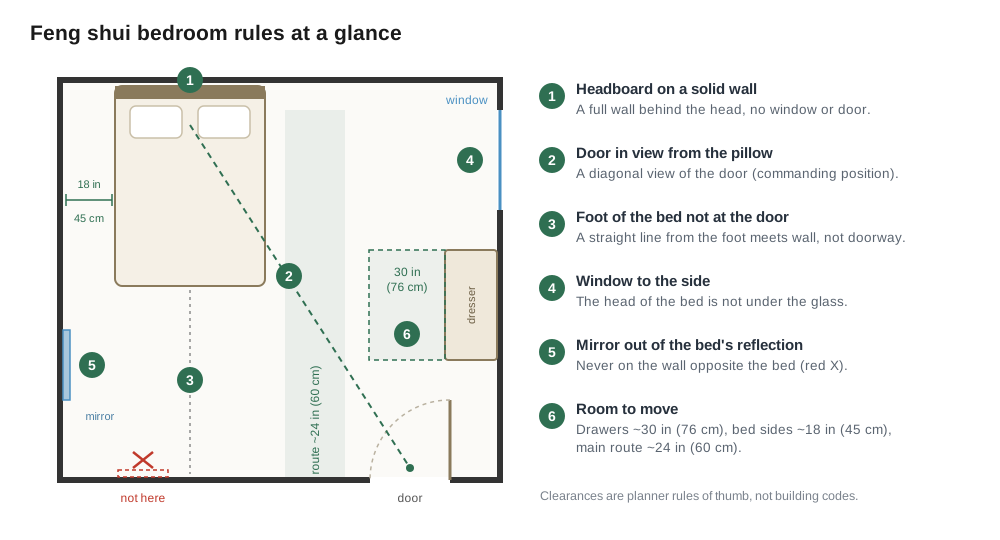
One room, six of the rules below. The bed claims the solid wall first, and everything else is arranged around it.
Short answer: the core feng shui bedroom rules are about the bed. Put the headboard on a solid wall, keep the door in view without the foot of the bed pointing at it, keep the head out from under a window, and keep mirrors and screens from reflecting the bed. Then make sure drawers open and you can walk around the room easily.
How to use these feng shui bedroom rules
This page is the quick-reference version. Each rule gets a Do or Don't, a short reason, and a link if you want the longer explanation. If you'd rather work through a room step by step, our feng shui bedroom layout guide walks through it in order.
A note on how we frame these. Feng shui is a cultural tradition, and the reasons given here are traditional ones. Where a rule also has a plain practical reason, like being able to open a drawer or not having a heavy lamp over your head, we say so separately. None of these rules will change your luck or your sleep, and we don't claim they will.
Where to put the bed: rules 1 to 5
The bed has the most agreement across feng shui teachers, so it comes first. If you only follow five rules, follow these.
1. Do put the headboard against a solid wall
Do: rest the head of the bed against a full, unbroken wall.
Why: tradition reads a solid wall as support behind you while you sleep. Practically, a headboard on a wall stays put, and you get somewhere to lean when you sit up. See our guide to feng shui bed placement.
2. Do keep the door in view from your pillow
Do: place the bed so you can see the door from the pillow without turning your head much, usually from a diagonal.
Why: this is the commanding position. The traditional idea is that you can see who comes in. The everyday version is simpler: most people relax more when the entrance isn't behind them.
3. Don't point the foot of the bed straight at the door
Don't: line the bed up so the foot points straight out through the doorway.
Why: feng shui prefers that you not lie straight in the path of the entrance, where energy is said to rush in and out. Practically, hallway light and noise come straight at the bed. We define "bed facing the door" this narrowly: the foot of the bed points straight at the door. A door off to the side doesn't count. Our bed facing the door guide covers what to do when you can't move it.
4. Don't put the head of the bed under a window
Don't: use a window wall as the headboard wall if you have another option.
Why: feng shui sees glass behind the head as weak support. In practice, a window over the bed can mean drafts and early light, plus blind cords hanging near your head. If the window wall is your only option, see bed under a window for compromises.
5. Do leave both sides reachable if two people share the bed
Do: pull the bed away from the side wall so each sleeper has a way in and out.
Why: tradition prefers balance, with a side and a nightstand for each person. The practical case is stronger: nobody has to climb over a partner at night. For one sleeper, a bed against a side wall is a common compromise, covered in bed in a corner.
Mirrors and screens: rules 6 and 7
6. Don't let a mirror face the bed
Don't: hang a mirror, or use a mirrored wardrobe front, where it reflects the bed.
Why: feng shui treats a mirror facing the bed as unsettling, and many people simply dislike catching movement in a mirror at night. We apply this with no distance limit. A large mirror across a big room still counts if it shows the bed. Our bedroom mirror guide lists ways to move, angle, or cover it.
7. Don't leave a dark TV screen facing the bed
Don't: let a switched-off TV reflect the head of the bed.
Why: a dark screen behaves like a mirror, so the same rule applies. Check from the pillow with the TV off. If you can see the bed in the screen, a cabinet with doors or a cover at night solves it. More in TV in the bedroom.
What hangs overhead: rule 8
8. Don't sleep directly under a beam, heavy fixture, or ceiling fan
Don't: position the bed so a beam, chandelier, heavy pendant, open shelf, or fan sits right above it.
Why: tradition describes this as pressure on the person below. The practical reason is safety: anything mounted over a bed has to be fixed securely. If you can't shift the bed, check that fixtures are installed into solid structure and keep heavy decor off shelves above the headboard.
Feng shui furniture placement and clearance: rules 9 to 11
These rules are mostly practical. The numbers come from our planner's checks and are rules of thumb, not building codes. You can see how each check works on our methodology page.
9. Do give drawers and doors room to open fully
Do: leave about 30 in (76 cm) in front of a dresser, and check that wardrobe and closet doors swing open without hitting the bed.
Why: feng shui likes energy to move freely, and you need to stand in front of a drawer to use it. A drawer that only opens halfway gets annoying fast.
10. Do keep space beside the bed and a clear walking route
Do: aim for about 18 in (45 cm) beside each side of the bed that someone uses, and about 24 in (60 cm) along the main route from the door.
Why: a clear path is the practical side of good flow. It also matters at night, when you're walking half awake. Our bedroom size guide shows which bed sizes leave this much room.
11. Don't aim sharp furniture corners at the bed
Don't: let the corner of a dresser, desk, or shelf point straight at where you lie, especially near the head.
Why: feng shui calls these corners "poison arrows" and prefers that they not point at a sleeping person. Practically, a sharp corner at bed height is easy to knock a shin or hip on in the dark. Turning the piece or rounding the corner with a soft bumper fixes both concerns.
A desk in the bedroom: rule 12
12. Do place the bed first, then give the desk a wall behind you
Do: settle the bed before adding a desk, then sit with a wall behind you and the door in view if the room allows.
Why: the desk gets its own small version of the commanding position, but the bed keeps priority for the best wall. Keep the chair able to roll back without blocking the route to the bed. See feng shui desk placement.
Clutter and storage: rule 13
13. Do keep under-bed storage tidy and closed
Do: if you store things under the bed, use closed boxes or drawers with soft items like spare linens, and keep the floor and nightstands mostly clear.
Why: traditional advice prefers open space under the bed. Many people find a tidy room easier to relax in. It's also easier to clean and less likely to collect dust. This is about calm and ease, not about any outcome.
Colors and light: rules 14 and 15
14. Do choose calm, low-contrast colors
Do: pick soft, muted colors for walls and bedding, and save strong contrasts for small accents.
Why: feng shui sees the bedroom as a resting space, so calm colors are the usual pick. Low contrast also just looks quieter. Our feng shui bedroom colors guide has palettes.
15. Do make light easy to control
Do: use curtains or blinds you can close and lamps you can dim, rather than relying on one bright overhead light.
Why: tradition balances bright, active energy with quieter, restful energy, and the bedroom leans quiet. Practically, it's nice to be able to make the room darker or brighter without getting up.
When feng shui bedroom rules conflict
Real bedrooms rarely let you follow every rule. When two of them pull in different directions, use this order:
- Safety first. A securely fixed lamp, a clear route out, and a bed that isn't blocking a door come before any traditional preference.
- Daily use second. Drawers that open, a path you can walk, and a side for each sleeper come next.
- Feng shui preference third. Among these, a solid wall behind the head and a view of the door usually matter most. Reflections and windows come after.
For example, if the only solid wall puts the bed in line with the door, keep the solid wall and use a footboard, a bench, or a rug to soften the line. If the bed has to face a window rather than sit under one, that's usually the easier compromise, explained in bed facing a window. In a tight room the trade-offs pile up quickly, and our small bedroom guide covers which ones are worth making.
Be honest about the compromise you choose. A headboard, a mirror cover, or a cabinet for the TV reduces a problem. It doesn't make the problem disappear, and you don't need to pretend it does.
Feng shui bedroom rules checklist
Use this list for a quick check from the doorway:
- Headboard on a solid wall, not a window or the door wall
- Door visible from the pillow, ideally from a diagonal
- Foot of the bed not pointing straight at the door
- Head of the bed not under a window
- A reachable side for each sleeper
- No mirror reflecting the bed
- No dark TV screen reflecting the bed
- No beam, heavy light, or fan directly over the bed
- About 30 in (76 cm) in front of drawers, doors that open fully
- About 18 in (45 cm) beside the bed, about 24 in (60 cm) on the main route
- No sharp corners aimed at the bed
- Desk placed after the bed, with a wall behind the chair
- Under-bed storage closed and tidy
- Calm, low-contrast colors
- Curtains and lamps you can adjust
Sources and scope
These rules reflect common Form-school bedroom guidance shared across practitioner references such as Law of Feng Shui and Feng Shui Space Planner, and the "bed facing the door" discussion in Tom's Guide. The clearance figures are our planner's own layout checks, not building-code or accessibility requirements. These rules use the door, walls, windows, and furniture, not compass directions or birth dates. We keep tradition, everyday comfort, and safety separate, and we make no claims about luck, love, money, health, or sleep.
Check your own bedroom against the rules
A checklist is easier to apply to a drawing than to a room full of furniture. Draw your bedroom in the free planner with your real walls, door, and windows, place the bed, and see which of these rules your layout meets before you move anything heavy.
Frequently Asked Questions
What are the basic feng shui bedroom rules?
Put the headboard against a solid wall, keep the door in view from the pillow, and don't let the foot of the bed point straight at the door. Keep the head of the bed out from under a window, keep mirrors and dark TV screens from reflecting the bed, and avoid sleeping under a beam or heavy fixture. Then leave room to open drawers and walk around the bed.
Where should you not put a bed in feng shui?
Avoid a spot where the foot of the bed points straight at the door, where the headboard sits under a window or on the same wall as the door, where a mirror or TV screen faces the bed, or where a beam, heavy light, or ceiling fan hangs directly over it. A bed squeezed so tightly that drawers or doors can't open is also worth moving.
How much space should be around a bed?
Our planner uses about 18 in (45 cm) beside each side of the bed that someone uses, about 24 in (60 cm) for the main walking route, and about 30 in (76 cm) in front of drawers. These are layout rules of thumb, not building codes or accessibility standards, and some people need more room.
What if two feng shui bedroom rules conflict?
Put safety first, then everyday use, then feng shui preference. A secure, usable room comes before any traditional placement. Among feng shui preferences, a solid wall behind the head and a clear view of the door usually carry the most weight, and a remedy such as a headboard or a cover reduces a problem rather than erasing it.
Do these feng shui bedroom rules need a compass?
No. These rules are about where furniture sits relative to the door, walls, windows, and reflective surfaces, which is the Form-school approach. Compass and birth-date methods are a separate system, and none of these rules promise luck, love, money, health, or better sleep.