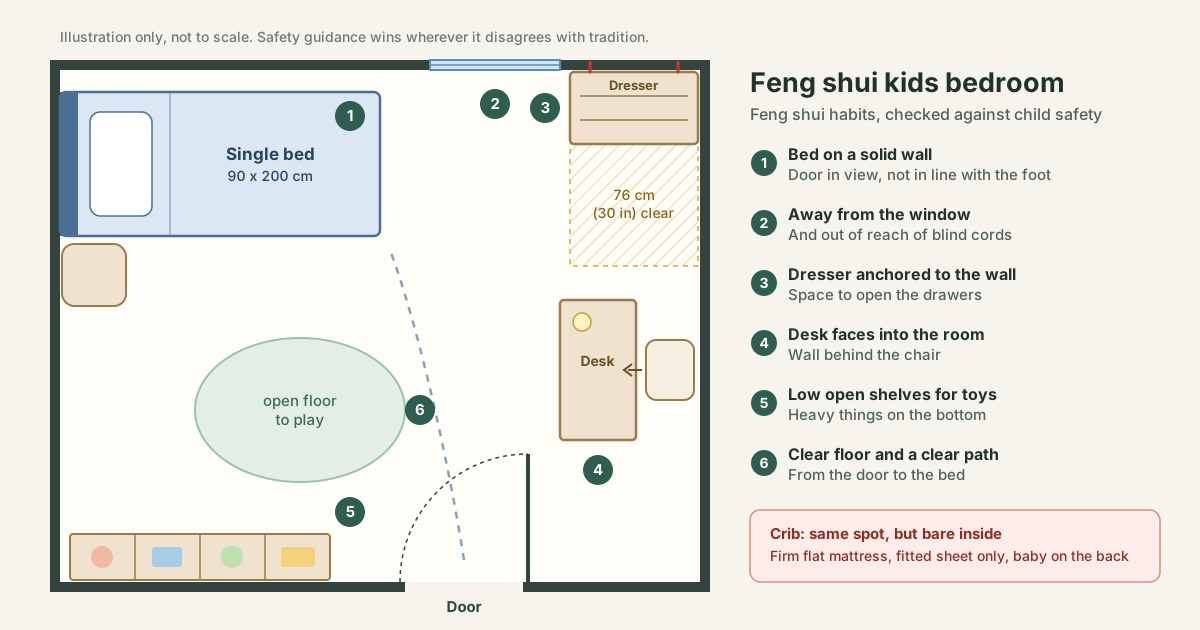
One child's room laid out with feng shui habits and safety checks together: bed on a solid wall, away from the window, furniture anchored, toys stored low and a clear floor.
Short answer: a feng shui kids bedroom follows the same layout ideas as an adult room. Put the bed against a solid wall where the child can see the door without lying in line with it, keep it out from under the window, face the desk into the room and store toys low. Where tradition and safety disagree, follow the safety guidance: a baby sleeps in a bare crib with only a fitted sheet, dressers and bookcases are anchored to the wall, cribs and beds stay away from window cords, and no child under 6 sleeps on a top bunk.
Feng shui in a child's room: what it can and can't do
Feng shui is a Chinese tradition about how rooms and buildings are arranged. We treat it as a cultural practice, not a science (our plain introduction to feng shui has the background), and nothing here will improve a child's grades, behaviour, health or luck. What it does give you is a short list of placement habits you can check by looking at the room. Most of them line up with child safety advice. Where they don't, this guide follows the American Academy of Pediatrics (AAP), the NIH Safe to Sleep campaign, the US Consumer Product Safety Commission (CPSC) and the NHS.
Where to put a child's bed
The main feng shui idea for any bed is the commanding position. Architect and feng shui consultant Anjie Cho describes it for a child as a spot where they can see the door, with the headboard against the far wall, diagonal from the door rather than right in front of it. Our guide to the commanding position explains the idea, and feng shui bed placement covers the full set of bed rules.
In a kid's room that comes down to four checks:
- Put the headboard on a solid wall. Feng shui writers see a bed in the middle of the room as unsettled, and a wall along one long side also stops pillows (and small children) from sliding off.
- Keep the door in view but not in line with the bed. If the foot of the bed points straight out of the door, slide the bed sideways. Our post on the bed facing the door has layouts for awkward rooms.
- Keep the bed out from under the window. Feng shui prefers a solid wall behind the head, and for children there is a safety reason too, covered in the crib section. See bed under a window for the tradition.
- Leave the space above the bed empty. Feng shui avoids beams, heavy fixtures and shelves over a bed, and with a child sleeping there it also means nothing can fall on them. The beam over the bed post covers ceilings.
Crib placement in a nursery
For a baby, the safety rules are stricter than any feng shui tip, so they come first, starting with where the crib lives. The AAP recommends that a baby sleep in the parents' room, in a crib or bassinet of their own, for at least the first 6 months. NIH Safe to Sleep says the same: room-share, but don't bed-share. The NHS gives the same 6 months for a cot or Moses basket in your room. For many families, then, the first nursery layout is a crib in the parents' bedroom, near the adult bed.
The crib itself stays bare. Feng shui decorating advice often leans on soft textures, but none of that goes in the crib. Safe to Sleep says to remove everything from the baby's sleep area except a fitted sheet, including soft objects, toys, pillows, blankets and crib bumpers. The AAP adds a firm, flat mattress and back sleeping for every nap and every night. CPSC sums it up as "Bare is Best."
Placement starts with windows and cords. CPSC says to move all cribs, beds, furniture and toys away from windows and window covering cords, preferably to another wall, and to install cordless window coverings. The NHS adds that a baby shouldn't sleep next to a radiator, heater or fire, or in direct sunlight. This happens to match the feng shui dislike of a bed under a window.
After that, feng shui can have its say. Feng shui author Donna Stellhorn told Romper that an infant will be more comfortable sleeping next to a solid wall. She also suggested keeping the crib away from tall, heavy furniture and out of the middle of the room, with nothing heavy, lighting included, over or near it. A crib on a solid inside wall, away from the window, with a view across to the door, meets both lists. Hang framed art and shelves on another wall.
Desk and study corner
A homework desk follows the same logic as the bed: a wall behind the chair and the door in view. Our feng shui desk placement guide goes through the options, including rooms where the only free wall faces away from the door. House Digest's guide to a feng shui kids room adds that the work area should be bright and free of clutter and electronics.
Where there is space, face the desk into the room or set it side-on to a wall, so the child isn't sitting with their back to the door. Leave room to push the chair back. Our planner treats about 45 cm (18 in) behind a desk chair as the minimum and 60 cm (24 in) as comfortable.
Toys, storage and clutter
Most kids bedroom ideas, and most kiddies room decor, start with storage, because toys spread. Romper's article suggests keeping toys in baskets and storage bins. House Digest suggests enough storage, clearing out broken toys and outgrown clothes, and rotating toys so fewer are out at once.
Two safety points decide how that storage works. First, anchor anything that can tip. CPSC's Anchor It campaign says anchoring all furniture with drawers, doors and shelves to the wall prevents tip-over injuries and deaths. In a 2026 release, CPSC said 71% of the people killed in tip-overs from 2013 to mid-2023 were children aged one to three, and advised keeping toys and remotes off higher shelves, because children climb to reach them. A mandatory US stability standard for dressers took effect in September 2023, and CPSC still advises anchoring.
Second, keep under-bed storage simple. Anjie Cho discourages it and says that if you need it, keep it to soft, sleep-related items like pillows and blankets. Lidded drawers of spare bedding are a fair compromise, and our guide to bedroom clutter covers the rest.
Put favourite toys in low, open bins a child can reach without climbing. Leave an open patch of floor for play; a rug gives it an edge and keeps the route from the door to the bed clear.
Colors
Feng shui color advice for children varies between sources. Donna Stellhorn, in Romper, recommends soothing, muted combinations such as green and blue for a nursery and says bright colors like red or orange may keep a baby awake. House Digest suggests white or pastel walls. Anjie Cho's nursery color article gives two routes: a color you are drawn to, or one chosen to support the baby's birth element using the Nine Star Ki system.
A simple way to use all of this is to keep the walls calm and put brighter colors in bedding, rugs, art and bins, which are easy to change as a child grows. Let older children pick their own accents. Our bedroom colors guide covers restful palettes and the five-element color labels.
Lighting, screens and sleep
The CDC recommends 12 to 16 hours a day for babies aged 4 to 12 months, 11 to 14 hours for ages 1 to 2 and 10 to 13 hours for ages 3 to 5, naps included. For ages 6 to 12 it recommends 9 to 12 hours, and for teens 8 to 10.
Screens are the biggest light problem in most kids rooms. The AAP's HealthyChildren site recommends keeping all screens, including TVs, computers, tablets and phones, out of children's bedrooms, especially at night, and turning them off at least 60 minutes before bedtime. Feng shui writers treat a dark screen facing the bed much like a mirror; see our post on the TV in the bedroom.
Stellhorn told Romper to use natural light in the day and keep the nursery dark at bedtime. A dim night light low on the wall helps an older child find the door at night, and with a bunk bed HealthyChildren suggests placing one so the child can see the ladder. Our bedroom lighting guide covers lamps, bulbs and blackout curtains.
Shared rooms and bunk beds
Feng shui is not keen on bunk beds. Anjie Cho writes that they are not the best choice because they put physical and energetic pressure on both sleepers. Plenty of families need one anyway, and then the safety rules decide who sleeps on top and where the bed goes:
- No child under 6 sleeps on the top bunk. HealthyChildren says younger children don't have the coordination to climb safely or avoid falling out, and Nationwide Children's Hospital gives the same age.
- Nationwide Children's recommends guardrails on both sides of the top bunk, with gaps of 3.5 inches or smaller and rails at least 5 inches above the mattress. HealthyChildren adds that the top mattress should fit snugly in the frame.
- HealthyChildren suggests a corner with walls on two sides. Nationwide Children's says to keep the top bunk away from ceiling fans and not to let children play on the bunk or ladder or tie belts, scarves or ropes to it.
A bunk in a corner can still have a view of the door, which keeps some of the commanding position. Keep it away from the window and blind cords too.
With two separate beds, give each child a solid wall behind the headboard and, if the room allows, a view of the door. Two single beds along one wall with a nightstand between them, or an L-shape in a corner, are the usual answers. Our guides to the small bedroom and bedroom sizes help with what fits.
Age by age: nursery, young child, teen
Baby, up to about 12 months
- Crib in the parents' room for at least the first 6 months, firm flat mattress, fitted sheet only, baby on the back.
- Crib on a solid wall, away from windows, cords, heaters and direct sun. Dresser and changing table anchored.
Young child, about 1 to 5
- Toddler or single bed on a solid wall, door in view, not under the window. Bottom bunk only.
- Low, open toy storage with heavy things on the bottom shelf, and every piece with drawers or shelves anchored.
School age, 6 to 12
- A desk that faces into the room, with space to push the chair back.
- Top bunk allowed from age 6, with guardrails on both sides. Let the child choose some of the colors and decor.
Teen, 13 to 17
Teen boy bedroom ideas and teen girl rooms both tend to grow around the desk and the screens. Keep the bed in the commanding position, put a wall behind the desk chair, and charge the phone outside the room or at least across it. HealthyChildren notes that teens' sleep cycles shift later at puberty and warns against assuming they need less sleep than younger children.
Kids bedroom checklist
- Bed or crib against a solid wall, door in view, not in line with the foot.
- Bed or crib away from windows and window cords, with cordless blinds if you can.
- Nothing in the crib except a fitted sheet and the baby.
- Every dresser, bookcase and TV anchored to the wall.
- Toys in low, open bins, and nothing heavy hung over the bed or crib.
- A desk with room to push the chair back.
- Screens out of the bedroom at night and off an hour before bed.
- No child under 6 on a top bunk, and guardrails on both sides.
Plan the kids room on paper first
Moving a dresser you have already anchored is a chore, so draw your child's room in the free planner first. It works on one room in 2D, with its doors, windows and 12 furniture types: bed, desk, wardrobe, nightstand, dresser, mirror, TV, chair, bookshelf, sofa, storage trunk and vanity. There is no crib or bunk bed item. Use the single bed preset (90 × 200 cm) for a child's bed, or drag a bed's corners to your crib's measurements.
The planner checks door swing, about 76 cm (30 in) in front of drawers, 45 cm (18 in) beside the bed and 60 cm (24 in) for the main walking route. It also runs 8 placement rules, including the commanding position, no bed under a window and nothing heavy overhead, and it treats a bed as facing the door when the foot of the bed points directly at the door. The feng shui rules look at one bed (the first one placed), so in a shared room check the second bed yourself. You can trace over a floor-plan image, but the planner doesn't analyse photos, and it can't tell whether furniture is anchored, a crib is bare or a bunk has guardrails. Use the checklist for those.
Sources and scope
The feng shui points on bed placement, bunk beds and under-bed storage come from Anjie Cho's 6 brilliant feng shui tips for kids' rooms and children's room design and organization tips, and her nursery color routes from best feng shui colors for a baby's room. Donna Stellhorn's crib, color, lighting and toy storage advice is from Romper's feng shui tips for a baby's nursery. The desk, color and toy rotation points are from House Digest's how to feng shui your kid's bedroom.
Safe sleep guidance comes from NIH Safe to Sleep's ways to reduce the risk of SIDS, the AAP's parent's guide to safe sleep on HealthyChildren.org, the NHS page on reducing the risk of sudden infant death syndrome and CPSC's safe sleep page. Window cord advice is from CPSC's go cordless with window coverings release. Furniture anchoring comes from CPSC's Anchor It campaign and its 2026 release urging families to anchor TVs and furniture. Bunk bed rules come from HealthyChildren's bunk beds safety information for parents and Nationwide Children's Hospital's bunk bed safety. Sleep hours are from the CDC's about sleep page, and screens and teen sleep from HealthyChildren's healthy sleep habits: how many hours does your child need. The clearance figures are our planner's layout checks, not building codes. We keep feng shui tradition and child safety separate, put safety first wherever they disagree, and make no claims about grades, behaviour, health, sleep or luck.
Frequently Asked Questions
Where should a child's bed go in feng shui?
In the commanding position: headboard against a solid wall, with a view of the door but not lined up with it. Feng shui consultant Anjie Cho describes it for a child as diagonal from the door rather than straight in front of it. Keep the bed out from under the window and keep shelves and heavy frames off the wall above it. If the room only allows one spot, a safe bed in a slightly imperfect position is better than a perfect position with a hazard.
Where should a crib go in a feng shui nursery?
Start with safe sleep rules. The AAP and NIH Safe to Sleep recommend that a baby sleep in the parents' room, in their own crib or bassinet, for at least the first 6 months, on a firm flat mattress with only a fitted sheet. CPSC says to keep cribs away from windows and window covering cords. Within those limits, feng shui writers prefer the crib on a solid wall, out of the middle of the room and away from tall, heavy furniture.
Are bunk beds bad feng shui?
Some feng shui consultants dislike them. Anjie Cho writes that bunk beds put pressure on both the child above and the child below. Many families still need one, and the safety rules matter more than the tradition: the AAP's HealthyChildren site says no child under 6 should sleep on the top bunk, and Nationwide Children's Hospital recommends guardrails on both sides of the top bunk and keeping it away from ceiling fans.
What colors are good for a kids bedroom in feng shui?
There is no single rule. Feng shui author Donna Stellhorn told Romper that muted combinations such as green and blue suit a nursery, and House Digest suggests white or pastel walls. Anjie Cho suggests either a color you are drawn to or one matched to the baby's birth element. A practical approach is calm walls with brighter colors in bedding, rugs and bins that are easy to change as the child grows.
Can your planner lay out a kids room or nursery?
Partly. The planner draws one room in 2D with doors, windows and 12 furniture types, and checks clearances, door swing and 8 placement rules. It has no crib or bunk bed item, so use the single bed preset or drag a bed's corners to your crib's size. The feng shui rules look at one bed, so in a shared room check the second bed yourself. It cannot tell whether furniture is anchored, a crib is bare or a bunk has guardrails, and it does not analyse photos.