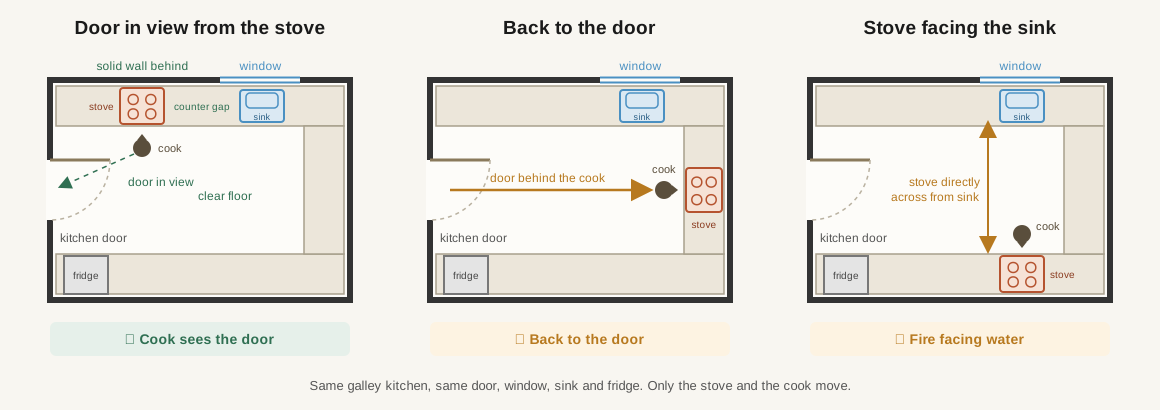
One galley kitchen, one door, one window, the same sink and fridge. Only the stove moves. On the left the cook can see the door, and the stove has a counter between it and the sink.
Short answer: in a feng shui kitchen, start with the stove. Put it against a solid wall where the cook can see the kitchen door at an angle, not straight in line with it. Keep a stretch of counter between the stove and the sink or fridge, keep the stove clean and working, and clear the counters. Layout and color come after that.
Why feng shui pays attention to the kitchen
Feng shui is a Chinese tradition about how homes and rooms are arranged. We treat it as a cultural practice, not a science, and our plain introduction to feng shui covers where it comes from.
In the tradition, the kitchen is the room of nourishment. Architect and feng shui teacher Anjie Cho says the kitchen represents how we nourish ourselves. The stove gets the most attention because it cooks the food and carries the fire element. Many practitioners also tie the stove to a household's resources. You will see that link everywhere, but we make no promises about what moving a stove does. Below we keep tradition, everyday comfort and safety apart.
Feng shui stove placement
The stove rules are the commanding position applied to the person cooking. Tradition wants:
- the cook able to see the kitchen door while standing at the stove
- the door seen at an angle, not straight ahead in line with the stove
- a solid wall behind the stove, not a window or open space
- the stove clean and in working order
Anjie Cho describes the goal as seeing the room and the people coming in, with your back not to the door, and PODS's kitchen feng shui article also says you should be able to see the main entryway while cooking. The solid wall behind the stove borrows the same logic that puts a solid wall behind a bed. Our guide to the commanding position in feng shui explains the idea with a bed and a desk.
In the left panel of the diagram, the stove sits on the long wall near the door, so the door is off to the cook's side. The middle panel shows what tradition avoids: the stove on the far end wall, with the cook's back to the door.
If you can't see the door from the stove
A stove against a wall means the cook faces the wall, and the door often ends up behind. The traditional workaround is a small mirror or reflective surface placed so you can see the doorway while cooking. A shiny backsplash can do the same job. A mirror near the stove should tolerate heat and grease. Plenty of people skip this and glance over their shoulder, which is fine too.
Keep the stove clean and working
Feng shui writer Michele Duffy advises keeping the stove spotless and in good working order, and using all the burners in rotation. Symbolism aside, a burner that won't light is worth fixing.
Fire and water: the stove, the sink and the fridge
The stove is fire. The sink, the dishwasher and, in most writing, the fridge are water. In the five elements, water dampens fire, so tradition prefers that the stove not face the sink head on or sit pressed against it. The right panel of the diagram shows the classic case: stove and sink directly across a narrow galley aisle.
Sources vary on how strict this is:
- PODS suggests keeping the stove from sitting side by side with the sink or fridge where possible.
- Michele Duffy says to keep the sink and fridge from sitting directly next to the stove.
- A geomancer quoted by Home & Decor Singapore is more relaxed: a stove and sink side by side or at a right angle are acceptable, and if they face each other, a small plant between them helps. The plant stands for wood, which in the five elements is fed by water and in turn feeds fire.
Other common softenings are a stretch of counter or a wooden cutting board between the two.
What kitchen designers say
The kitchen work triangle, linking the sink, the stove and the fridge, is a common design guideline that goes back to kitchen studies in the 1920s and 1940s. It wants the three fairly close together. National Kitchen and Bath Association guidelines, as summarized by a design-build firm, suggest each leg run 4 to 9 feet, with a total of no more than 26 feet, and at least 12 inches of counter on one side of the cooktop and 15 inches on the other.
So the two ideas meet in the middle. Keep the sink, stove and fridge within easy reach, with a working stretch of counter beside the stove instead of the sink or fridge pressed against it.
Kitchen facing the front door
Many writers prefer that the stove not be the first thing you see from the front door. PODS, for example, says a kitchen is best placed near the back door rather than the front door. You can't move a kitchen without remodeling, so the usual fixes are about the view:
- Keep a kitchen door closed if there is one.
- Put a screen, a bookcase or a tall plant where it breaks the straight line from the front door to the stove.
- If you are remodeling, place the stove where it is seen from the side when you walk in.
In many apartments the kitchen is right by the entry, and that is just how the home is built. Our post on feng shui for the front door covers the entry itself.
Kitchen in the center of the house
Michele Duffy suggests avoiding a kitchen in the middle of the home and placing it toward the back when you have a choice. You rarely do, unless you are building. If yours is central, keep it tidy and well lit, with clear walking routes through it.
Islands and kitchen layouts
Feng shui notes on layout mostly come back to the stove:
- Galley: two facing runs of counter. Offset the stove and sink so they are not directly across from each other, as in the left panel.
- L-shaped: the stove and sink often land on different walls at a right angle, which the Home & Decor geomancer accepts.
- U-shaped: three walls leave room to put the stove where the door is in view.
- Open plan: the stove is often visible from the living area or the front door. A partial wall, a shelf or an island can break the view.
For a kitchen island, Michele Duffy calls a stove on a center island the ideal commanding position, because the cook faces the room and the door.
Colors and the five elements
Feng shui links colors to five elements: wood (green and brown), fire (red and orange), earth (yellow, beige and terracotta), metal (white, gray and metallics) and water (black and dark blue). Sources vary on which suit a kitchen. Anjie Cho and Michele Duffy both mention white because it shows off the color of food, and Cho adds that you shouldn't avoid a color you love out of fear. A simple approach is calm walls with one or two element colors in towels or dishes. Our five elements chart lists the colors, shapes and materials for each.
Clutter, knives and fresh food
- Clear the counters, and don't leave dirty dishes in the sink overnight, as Duffy suggests. A clear counter is also easier to cook on.
- Store knives rather than display them. Tradition dislikes sharp points left out, and Duffy advises keeping knives off the countertops. A drawer insert or knife block also keeps blades away from small hands.
- Keep the fridge and pantry fresh, and add herbs on a sunny sill if you have the light.
The bedroom next to the kitchen
A bed against the stove wall
Traditional advice prefers that the headboard not sit against a wall that has the stove on the other side. It follows the same shared-wall logic as a toilet behind the bed, which we cover in our post on the bed against a bathroom wall. The practical side is plainer: some walls carry heat from an oven, and a range hood, cooking noise or a humming fridge can carry through a thin wall to someone asleep on the other side. If another solid wall works for the headboard, use it. If not, a padded headboard and a small gap from the wall help with sound.
A kitchen beside or below a bedroom
In apartments the kitchen is often next to the bedroom, or a neighbor's kitchen sits below it. You can't move a neighbor's stove, so focus on what you control: which wall the headboard rests on. Our guide to feng shui bed placement walks through the options in order.
Small kitchens and rentals
- If you can't see the door from the stove, add a small heat-safe mirror or use a reflective backsplash panel.
- Keep a cutting board or a stretch of clear counter between the stove and the sink.
- If the stove is visible from the front door, add a screen, a curtain or a tall plant.
- Clear the counters, store the knives and keep the stove clean.
- Add a plant or fresh herbs and one element color in towels or a rug.
For a studio kitchenette, our guide to feng shui in an apartment covers zoning a small space.
Kitchen safety
This part is not tradition. The U.S. Fire Administration's advice is to stand by your pan and turn the burner off if you leave the kitchen, keep anything that can catch fire away from the stovetop, turn pot handles toward the back and keep a lid nearby to smother a pan fire. A towel, curtain or plant does not belong beside a burner, whatever an element chart says.
Feng shui kitchen checklist
- The stove is against a solid wall, and the cook can see the kitchen door at an angle or in a mirror.
- The stove is not straight in line with the kitchen door or the front door.
- There is a stretch of counter, a board or a plant between the stove and the sink or fridge.
- The sink, stove and fridge are still within easy reach of each other.
- The stove is clean and every burner works.
- Counters are clear, dishes are done and knives are stored.
- Nothing that can burn sits near the stovetop.
- No bed headboard sits on the other side of the stove wall.
Use the planner for the bedroom next door
Our planner is built for bedrooms and does not plan kitchens: it has no stove, sink or counters. It lets you draw your bedroom in the free planner as one room with its doors and windows, place the bed and other furniture, and check clearances, door swing and its 8 bedroom placement rules. If your bedroom shares a wall with the kitchen, draw the bedroom and keep the headboard off that wall. It is a 2D drawing tool: you draw the room yourself, and it does not read photos or floor plans.
Sources and scope
The kitchen as nourishment and the stove with the door in view, not in line with it, follow Anjie Cho's conversation on feng shui when renovating a kitchen, and the white kitchen and color choice points follow her feng shui kitchen post. The relaxed view on stove and sink and the plant between them come from Home & Decor Singapore's where not to put your stove and sink. The stove upkeep, central kitchen, knife, sink and island points follow Michele Duffy's Lamorinda Weekly columns on kitchen feng shui for the fall and the kitchen and the fire element. Seeing the entryway from the stove, keeping the stove apart from the sink and fridge, the kitchen near the back door and the mirror workaround appear in PODS's kitchen feng shui article. The work triangle history comes from Wikipedia's kitchen work triangle article, and the triangle and landing area figures from CRD Design Build's summary of NKBA kitchen guidelines. The element cycles follow Wikipedia's wu xing article, and the safety points the U.S. Fire Administration's cooking fire safety page. We keep tradition, everyday comfort and safety separate, and make no claims about luck, money, health or family life.
Frequently Asked Questions
Where should the stove go in a feng shui kitchen?
Feng shui tradition puts the stove against a solid wall, in a spot where the cook can see the kitchen door at an angle without standing directly in line with it. That is the commanding position applied to cooking. If the cook has to stand with their back to the door, a small mirror or reflective surface beside the stove is the usual traditional workaround.
Is it bad feng shui to have the stove facing the sink?
Tradition treats the stove as fire and the sink as water, and prefers that they not face each other head on or sit right against each other. Sources vary on how strict this is. Some practitioners are fine with a stove and sink side by side or at a right angle, and when they face each other the common softening is a stretch of counter, a wooden board or a small plant between them. It is a preference, not a warning sign.
What if my kitchen faces the front door?
Many feng shui writers prefer that the stove not be the first thing you see from the front door. Simple fixes are to keep a kitchen door closed, add a screen, a bookcase or a tall plant to break the line of sight, or angle the view so the stove is seen from the side. In an open-plan home this is common, and you can treat it as a matter of taste.
Can I put my bed against a wall that shares the stove?
Traditional advice prefers that the headboard not sit against a wall with the stove on the other side, much like a bathroom wall. There are plain reasons too: some walls carry heat, cooking noise and fridge hum. If another solid wall works for the headboard, use it. If not, a padded headboard and a small gap from the wall help.
Can your planner design a kitchen?
No. The planner is built for bedrooms. It draws one room with its doors and windows and checks clearances, door swing and 8 bedroom placement rules, and it has no stove, sink or counters. If your bedroom shares a wall with the kitchen, draw the bedroom and keep the headboard off that wall.