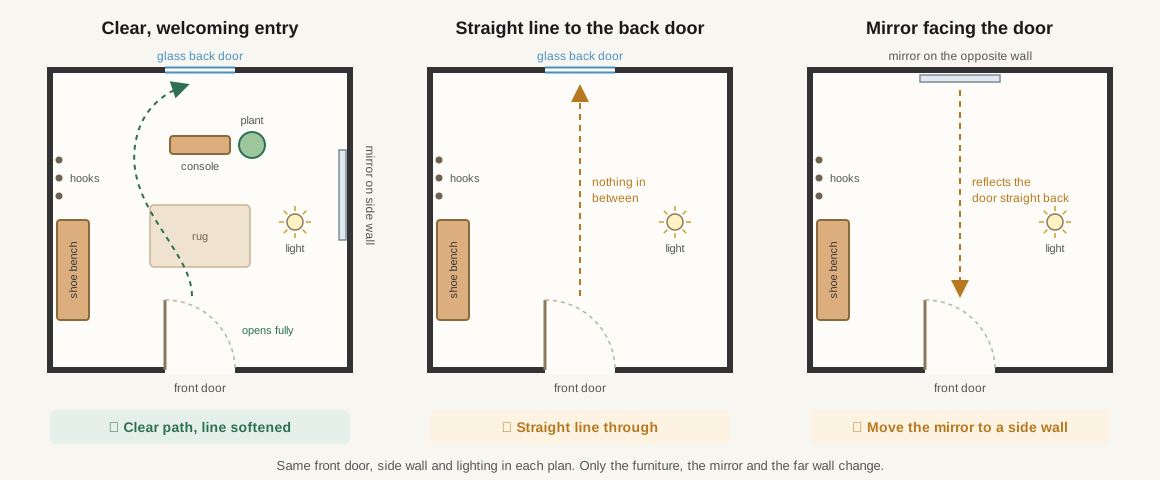
One entry hall, one front door. On the left the line to the back door is softened and the mirror sits on a side wall. The other two plans show layouts feng shui writers often flag.
Short answer: feng shui tradition treats the front door as the mouth of the home, so the advice starts with a clear, well-lit path, a door that opens all the way and a spot to drop your things. The usual adjustments are to soften a straight line to the back door, keep mirrors off the wall facing the door and pick a door color that suits its compass direction. House facing direction matters only in Compass School feng shui, and no direction is bad in a practical sense.
Why feng shui calls the front door the "mouth" of the home
Feng shui writers, including the practitioners Anjie Cho and Michele Duffy, often call the front door the mouth of qi (or chi). The idea is that energy enters a home there, so the door and the space just inside it get extra attention.
You don't have to believe in qi to see why the idea stuck. The entry is the first thing you see when you get home, and it is where shoes, mail and bags pile up first. Feng shui is a cultural tradition, and most of its entry advice is plain good sense about how a doorway gets used.
Entryway basics that work in any home
Most feng shui guides start with the same short list:
- Clear the path to the door. Trim bushes that hide it, move bins and bikes, and make the house number easy to read.
- Light it well: a porch light outside and a switch by the door inside.
- Let the door open fully. Cho suggests checking that every door opens at least 90 degrees, with nothing hung on it or parked behind it.
- Give things a landing zone: a bench, a shoe rack, hooks and a tray for keys.
Safety is a separate question from feng shui. The U.S. Fire Administration's escape planning advice says to know two ways out of every room and to keep doors and windows unblocked.
If the entry fills up fast, the habits in our bedroom clutter guide work just as well by the door.
Common front door situations and the usual fixes
Front door in line with the back door or a big window
This is the middle plan above. When the front door looks straight through to a back door, a patio door or a large window, tradition says qi moves through too quickly instead of settling. Jane Langof, quoted by Livingetc, is one of many practitioners who flag it.
The usual fix is to break the line without blocking it. A rug, a round table, a console, a large plant or a folding screen partway along all work, as long as you can still walk to the back door easily.
Stairs facing the front door
Tradition says qi runs down a staircase that faces the front door and straight out. Master Sean Chan, a practitioner who writes about classical sources, says the concern is strongest when the stairs line up directly with the door and sit close to it. He calls a stair offset by about 30 degrees a mild case, and notes that the older texts don't clearly support the idea.
Common adjustments are a console or plant at the foot of the stairs, a rug that ends before the bottom step, or a screen between the stairs and the door. The practical point: the foot of the stairs and the door share a busy patch of floor, so keep it clear and well lit.
Mirror facing the front door
This is the right-hand plan above. Most practitioners advise against a mirror on the wall directly across from the front door, because tradition says it sends incoming energy straight back out. Lali Kafi Gonzalez, quoted by Livingetc, suggests hanging it at a right angle to the door instead. Michele Duffy notes that feng shui sources disagree on this one, and that a mirror can make a small, dark foyer feel bigger.
The usual middle ground is a mirror on a side wall, which still brightens the entry. Our guide to a mirror facing the door goes through the disagreement in more detail.
Front door opening onto a wall
Tradition sees a wall a few feet inside the door as cramped, as if energy hits it on the way in. The common fixes make that wall worth looking at: art, a console with a lamp, or a plant to one side. Some writers suggest a mirror there for depth, which runs into the mirror question above. Art and good lighting avoid the argument.
Front door in line with a bedroom or bathroom door
Feng shui writers generally prefer that you can't see into a bedroom from the front door. Anjie Cho, writing about studios, suggests keeping the bed out of view of the entry. If a bathroom door lines up with the front door, the usual advice is to keep it closed. Both also help privacy when someone is at the door. For a bedroom and bathroom in line, see our post on a bedroom door facing a bathroom door.
Feng shui front door colors by direction
Many feng shui guides match the compass direction the door faces to one of the five elements, following the traditional wu xing pairings. Some also allow the color of the element that feeds it in the generating cycle, which is the last column.
| Door faces | Element | Common colors | Also suggested by some sources |
|---|---|---|---|
| North | Water | Black, dark blue | White, gray (metal) |
| South | Fire | Red, orange, strong pink | Green (wood) |
| East, southeast | Wood | Green, natural wood, brown | Navy, charcoal (water) |
| West, northwest | Metal | White, gray, metallic | Beige, soft yellow (earth) |
| Northeast, southwest | Earth | Yellow, beige, terracotta | Red, orange (fire) |
Sources vary on the details, and some writers, Anjie Cho among them, mention red as a choice for any door because tradition treats red as auspicious. Our five elements guide has the full chart and both cycles.
Two practical checks come first. If you have an HOA or rent, check the rules before you paint. And pick a shade you like seeing every day. A color chart is a tradition to borrow from, not a formula for results.
How practitioners find your house facing direction
The facing direction is the side of the house that "faces" outward, and the sitting direction is the opposite side. Most beginner guides keep it simple and use the side with the front door.
Classical practitioners sometimes use a different side. LoveToKnow's guide describes the facing side as the one that overlooks the most activity, such as a busier street. If the front door is on a quiet side street and a busy road runs along another side, they would read the busy side, but only if that side also has a door. If it doesn't, they use the front door.
To take the reading:
- Stand outside, a few feet from the front of the house, with your back to it.
- Take off metal jewelry and a watch, and move away from cars, railings and metal gates.
- Hold a compass or a calibrated phone compass level and read the direction you are looking.
- Take a second reading a step to one side to check.
What Compass School does with the facing direction
Form School feng shui looks at the shape of the land, rooms and furniture. Compass School adds directions, starting from the house facing direction. Systems such as Eight Mansions and Flying Stars use it to map the home, and Eight Mansions pairs it with a personal Kua number worked out from your birth year and, in most versions, your gender. You can look yours up with our Kua number calculator.
Compass School is a tradition, and its systems often disagree with each other. Wikipedia's feng shui article notes there is no empirical evidence that feng shui is effective, and that practitioners often give conflicting advice. Treat it as cultural reference. The entry basics above work whichever way your house faces.
Is a north-facing house bad feng shui?
No. Compass systems rate directions differently, and some popular writing favors south-facing homes, but no direction is bad in a practical sense. The differences that matter day to day are about climate.
In the Northern Hemisphere, a north-facing house usually has its back to the south. The U.S. Department of Energy's passive solar guidance favors windows within 30 degrees of true south for winter heat, with less glass on north walls in cold climates. So a north-facing house often gets its best winter sun in the back rooms, while the front step stays shadier and can hold ice longer. In a hot climate that shade can be a plus.
Bed direction works the same way: it depends on the system and the person. Our bed direction guide explains why placement matters more than a compass heading.
Apartments: which door counts as the front door?
Most modern feng shui writing treats the door to your unit as the front door, not the lobby entrance. So the entry advice applies to the strip of floor inside your apartment door: a clear swing, hooks or a shoe rack, a light, and no mirror straight across. Our apartment feng shui guide covers studios and small rentals.
When the front door opens into a small living room
Plenty of homes have no foyer, and the front door opens straight into the living room. The usual fix is an entry zone without walls:
- Keep the door swing and a route into the room clear. Our planner uses about 24 in (60 cm) as a rule of thumb for a main route.
- Mark the entry with a small rug, a narrow bench or a slim console.
- A low bookcase or slim console can act as a divider between the door and the seats. Leave walking room around it, and avoid putting the sofa's back to the door if another wall works.
- If the door lines up with a window, a plant or side table partway along breaks the line.
Our living room feng shui guide covers sofa placement and the rest of the room.
Front door and entryway checklist
- The path to the door is clear, and the house number is easy to see.
- The door opens fully, with nothing hanging on it or parked behind it.
- Shoes, bags and keys have a bench, rack, hooks or tray.
- A straight line from the front door to a back door or big window has a rug, plant, table or screen partway along.
- Stairs that face the door have a clear, lit landing at the bottom.
- No mirror hangs directly across from the front door. A side wall works instead.
- A bathroom door in view of the entry stays closed.
- The door color is one you like and one your HOA or lease allows.
- The front door, and at least one other way out, are never blocked.
Plan the bedroom behind the front door
Our planner is built for bedrooms, not entries or whole houses. You draw one room in the free planner with its doors and windows, place the furniture, and it checks clearances, door swing and 8 bedroom placement rules, including a bed whose foot points straight at the bedroom door. It is a 2D drawing tool: you draw the room yourself, since it does not read photos or floor plans, and it does not take compass readings or plan a front entry.
Sources and scope
The mouth of qi idea and the front door upkeep points come from Anjie Cho's front door feng shui post, her feng shui doors post (doors opening 90 degrees, nothing behind them) and her studio apartment tips, plus Michele Duffy's columns on front entrances and mirrors in Lamorinda Weekly. The straight-line and mirror points draw on Livingetc's entryway feng shui rules and entryway mistakes. The stair and wall points follow Master Sean Chan on stairs facing the door and a front door opening into a wall. House facing and compass readings follow LoveToKnow's feng shui house direction guide and Homedit's guides to north-facing and east-facing houses, which also list door colors. The element, direction and color pairings follow Wikipedia's wu xing article, and the schools and evidence notes its feng shui article. Sun and window orientation comes from the U.S. Department of Energy's passive solar home design fact sheet, and exits from the U.S. Fire Administration's home fire escape plans page. The walking-route figure is our planner's rule of thumb, not a code. We keep tradition, everyday comfort and safety separate, and make no claims about luck, money, love, health or opportunity.
Frequently Asked Questions
What does feng shui say about the front door?
Feng shui tradition calls the front door the mouth of qi, the place where energy is said to enter the home. The usual advice is practical: a clear, well-lit path to the door, a door that opens fully, nothing piled behind it, and a tidy landing spot for shoes, bags and keys. Treat it as a cultural tradition, not a promise of results.
Is a mirror facing the front door bad feng shui?
Most practitioners advise against hanging a mirror directly across from the front door. Tradition says it sends incoming energy straight back out. A few writers disagree, and some like a mirror in a dark foyer because it makes the space feel bigger. The common middle ground is a mirror on a side wall, at a right angle to the door.
How do I find the facing direction of my house in feng shui?
Stand outside a few feet from the front of the house, with your back to it, and take a compass reading of the direction you are looking. Keep away from cars, and take off metal jewelry and watches. Many practitioners use the front door side. Some use the side that faces the busiest street instead, if that side also has a door.
Is a north-facing house bad feng shui?
No direction is bad in a practical sense. Compass School systems rate directions differently, and they do not agree with each other. The real differences are about climate. In the Northern Hemisphere, a north-facing house usually has its back to the south, so the rear rooms and yard get the most direct sun, and the front step may stay shaded in winter.
What color should my front door be in feng shui?
Many feng shui guides match the door color to the compass direction the door faces through the five elements: dark blue or black for north, red or orange for south, green for east and southeast, white or gray for west and northwest, and earthy yellows for northeast and southwest. Sources vary, so pick a shade you like within the range and check HOA or lease rules first.