Short answer: the feng shui five elements are wood, fire, earth, metal and water. Each one has traditional colors, shapes, materials, a compass direction and a season. Two cycles connect them. In the generating cycle, each element feeds the next. In the controlling cycle, each one checks another. In a bedroom, people mostly use the system as a vocabulary for color and material choices. It is a tradition, not a formula for results.
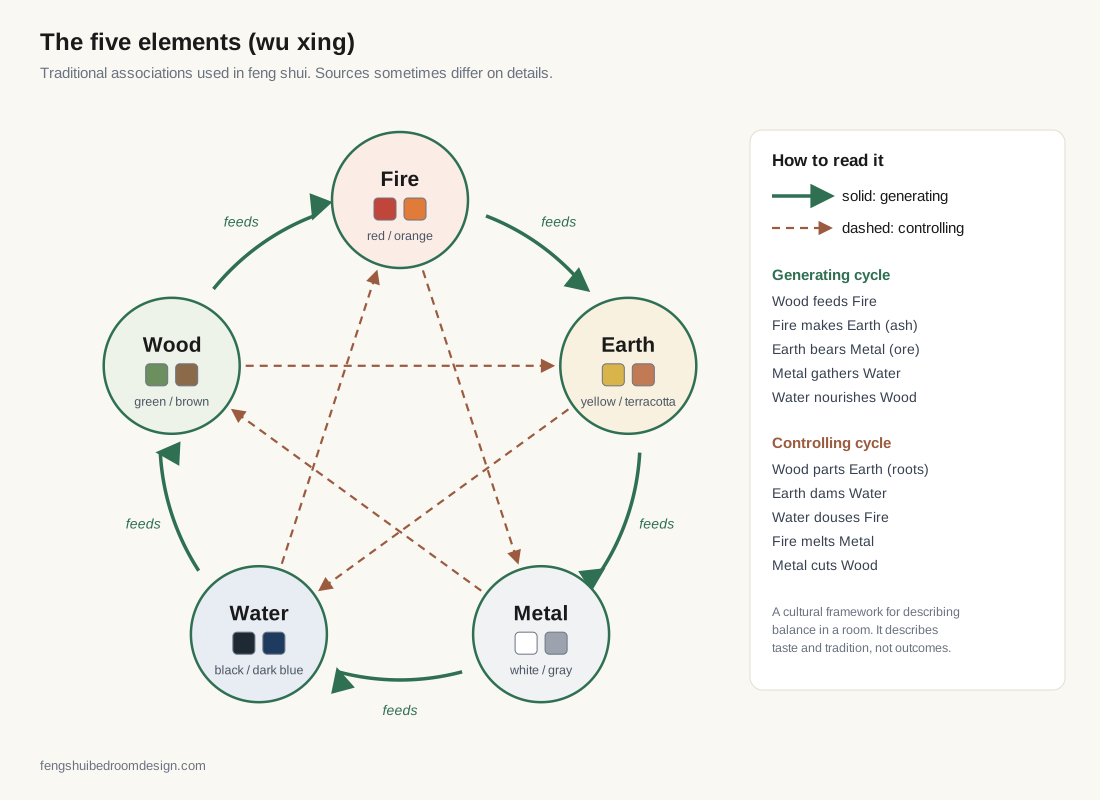
Solid arrows run the generating cycle clockwise around the outside. Dashed arrows trace the controlling cycle as a star inside. Each element shows two of its traditional colors.
What the five elements are
The five elements come from wu xing, a Chinese way of describing change. The word "elements" is a loose translation. Wu xing is closer to five phases or five movements, because the system cares about how things turn into each other more than about what they are made of.
Feng shui uses the five elements to describe a room. A space full of tall plants and green fabric reads as wood-heavy. A room of white walls, chrome and round mirrors reads as metal. Practitioners look at that mix and suggest adding or toning down an element so the room feels more even.
There is a separate practice that works out a personal element from your birth date (part of what is called BaZi, or Four Pillars). We don't cover it here.
Feng shui five elements chart
This table lists the associations you will see most often. Sources sometimes differ, especially on colors. Classical Chinese sources give wood the color qing, usually translated as blue or cyan, while most modern feng shui guides say green and brown. Treat the chart as a common reference, not a fixed standard.
| Element | Colors | Shapes | Materials | Traditional direction | Season |
|---|---|---|---|---|---|
| Wood | Green, brown | Tall, columnar, rectangular | Timber, bamboo, rattan, plants | East, southeast | Spring |
| Fire | Red, orange, bright purple, strong pink | Triangles, points, flames | Candles, lamps, fireplaces | South | Summer |
| Earth | Yellow, beige, sand, terracotta | Square, low, flat | Stone, ceramics, clay, brick | Center, northeast, southwest | Late summer and the turns between seasons |
| Metal | White, gray, metallics | Round, oval | Brass, steel, iron, chrome | West, northwest | Autumn |
| Water | Black, dark blue | Wavy, curved, irregular | Glass, mirrors, fountains | North | Winter |
A note on the direction column. Directions belong to the compass school of feng shui, which matches each element to a sector of the home using a compass reading, as on a bagua map. Our planner doesn't use compass directions. It only checks placement in a measured drawing, so you can skip that column if you don't follow the compass approach.
The generating cycle
The generating cycle (sometimes called the productive or nourishing cycle) runs clockwise around the outside of the diagram:
- Wood feeds fire, because burning wood keeps a fire going.
- Fire makes earth, because a fire leaves ash behind.
- Earth bears metal, because ore and minerals form in the ground.
- Metal gathers water, because water beads on a cool metal surface.
- Water nourishes wood, because plants need water to grow.
In decor terms, the idea is that you can support an element by adding the one before it. If a room feels like it needs more earth, traditional advice might suggest a touch of fire, such as warm lamplight or a terracotta-red cushion. It is a design idea and nothing more.
The controlling cycle
The controlling cycle (also called the restraining or destructive cycle) is the dashed star inside the diagram. Each element keeps another in check:
- Wood parts earth, the way roots break up and hold soil.
- Earth dams water, the way a riverbank holds a river.
- Water douses fire.
- Fire melts metal.
- Metal cuts wood, the way an axe cuts a tree.
Practitioners use this cycle to tone things down. A bedroom that feels very fiery (lots of red, bright light, sharp angles) might get a little water or earth to calm it: a dark blue throw, a few stone or ceramic pieces. "Destructive" sounds dramatic, but in a room it only means keeping one element from taking over.
Using the five elements in a bedroom
Most feng shui writing treats the bedroom as a room for rest. So the usual advice is to lean on the quieter elements and keep the loud ones small. Earth tones, soft woods and muted metals make an easy base. Fire and strong water colors work better as accents.
In practice that often looks like:
- Sand, beige or warm white walls (earth and metal).
- A wood bed frame or nightstands in a medium or light tone (wood).
- One accent color from a livelier element, repeated two or three times, like a rust cushion, a rust throw and a print with the same rust in it.
For paint ideas and color schemes, our bedroom colors guide covers warm whites, sage, dusty blue and terracotta with notes on light direction and testing samples.
Balancing an all-white or all-dark room
An all-white, minimal bedroom with chrome lamps and a round mirror reads as strongly metal. Some people love that crisp look. If it feels cold to you, the chart suggests warming it with earth and wood. Try an oatmeal or sand duvet, a wood side table, a jute rug or a ceramic lamp base. You keep the white walls and just add texture and warmth.
A dark bedroom with navy or charcoal walls reads as water. It can feel snug, and a dark wall behind the headboard is a popular choice. If the whole room feels heavy, the controlling cycle points to earth (earth dams water). Add warm beige bedding, a tan rug or some terracotta pots. Warm lamplight, which feng shui counts as fire, also lifts a dark room in the evening.
Neither of these is wrong. The chart gives you a way to name what you're noticing.
Materials and textures
Materials carry the elements too, and in a bedroom they often matter more than paint because you touch them every day.
- Wood: solid wood frames and nightstands, rattan, bamboo. Plants count as wood as well. See plants in the bedroom for which ones suit low light.
- Fire: lamps, candles, and anything bright red or orange.
- Earth: ceramic lamps, stone coasters, clay pots, brick, wool in sandy colors.
- Metal: metal bed frames, brass or steel lamp bases, round mirrors, picture frames.
- Water: glass, wavy patterns and anything black or deep blue. Some guides file mirrors here and some under metal.
A bedroom that mixes three or four of these usually looks more finished than one built on a single material.
Fire in the bedroom
Traditional advice tends to keep fire low in bedrooms. Large areas of bright red, many strong lights or lots of pointed shapes are seen as too active for a room meant for rest. If you like red, the usual compromise is to keep it small, such as a cushion, a throw or a piece of art.
Candles are the classic fire object, and here the safety case is stronger than the feng shui one. The National Fire Protection Association advises blowing out all candles before you leave a room or go to bed, and reports that over a third of home candle fires start in the bedroom. A flameless LED candle gives the same warm glow without the open flame.
Water features in the bedroom
Feng shui advice often discourages fountains and fish tanks in bedrooms. The traditional reasoning is that moving water is too active for a room meant for rest.
There are plain practical reasons as well. A small fountain or an aquarium pump makes a constant sound that some people find hard to sleep next to. Open water adds moisture to a closed room. The EPA suggests keeping indoor humidity below 60 percent, and ideally between 30 and 50 percent, to limit mold. If you want the water element in a bedroom, a dark blue throw, a wavy-patterned rug or a photo of the sea does the job without the pump or the humidity.
What the five elements don't cover
The five elements describe how a room looks and feels. They say nothing about where the bed should go. Placement rules like keeping a solid wall behind the headboard, seeing the door from bed and not sitting directly in line with it come from a different part of feng shui called form school.
Our planner works only on that placement side. Its methodology page lists the eight checks it runs on a measured drawing, and none of them involve colors, elements or compass directions.
Sources and scope
The element cycles and the color, direction and season pairings follow the standard wu xing scheme summarized on Wikipedia's Wuxing (Chinese philosophy) page, which also lists the older blue (qing) color for wood. The extra directions for wood, earth and metal (southeast, northeast, southwest, northwest) come from the trigram arrangement on Wikipedia's Bagua page. Shape and material pairings match common feng shui decor guides such as Arcadium 3D's five elements explainer and The AstroTwins' feng shui elements guide, which differ slightly on colors. Candle advice comes from the NFPA's candle safety page, and the humidity range from the EPA's guide to mold and moisture. We present the five elements as a cultural tradition and decor vocabulary. They don't predict sleep, health, wealth, love or luck, and we don't compute personal birth elements.
Put the layout first
Colors and materials are easy to change later. Where the bed and the furniture sit is harder to fix once everything is in. Draw your bedroom in the free planner to check the placement, then use the five elements chart to choose the finishing touches.
Frequently Asked Questions
What are the five elements in feng shui?
Wood, fire, earth, metal and water. The system comes from the Chinese idea of wu xing, which describes five phases that feed and check each other. Feng shui borrows it to describe a room through colors, shapes and materials. Each element has a set of traditional associations, and practitioners use them to talk about whether a room feels balanced.
What colors go with each feng shui element?
The usual pairings are green and brown for wood, red and orange for fire, yellow, beige and terracotta for earth, white, gray and metallics for metal, and black and dark blue for water. Older Chinese sources give wood a blue or cyan, so lists do vary a little. In a bedroom, a muted version of each family is easier to live with than the full-strength color.
What is the five elements cycle?
There are two. In the generating cycle, each element feeds the next: wood feeds fire, fire makes earth, earth bears metal, metal gathers water, and water nourishes wood. In the controlling cycle, each element checks another: wood parts earth, earth dams water, water douses fire, fire melts metal, and metal cuts wood. Feng shui uses both to talk about adding or toning down an element in a room.
What are the feng shui earth element colors?
Earth is usually linked to yellow, beige, sand, tan and terracotta, with some sources adding light brown. These are some of the easiest colors to use on bedroom walls because the muted versions are calm and go with most wood floors. Stone, ceramics and clay are earth materials too.
Does the planner on this site use the five elements?
No. Our planner checks where furniture sits in a measured drawing: a solid wall behind the bed, a view of the door, mirrors, beams and similar placement rules. It does not score colors, materials, elements or compass directions. You can use the five elements on your own as a way to think about decor.