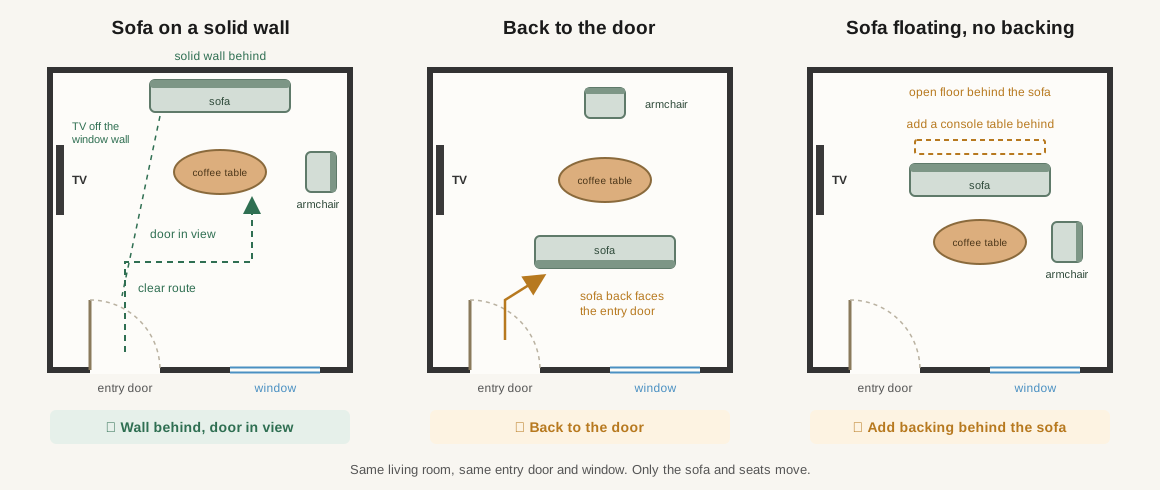
One living room, one entry door, one window. Only the sofa and seats move. On the left the sofa has a wall behind it and a view of the door.
Short answer: in a feng shui living room, start with the sofa. Put its back against a solid wall where you can see the entry door at an angle, not straight in line with it and never with your back to it. Then face the other seats toward the sofa around a coffee table, keep the TV out of window glare and leave a clear path from the front door.
What feng shui means for a living room
Feng shui is a Chinese tradition about how buildings and rooms are arranged. We treat it as a cultural practice, not a science, and our plain introduction to feng shui covers where it comes from.
Most feng shui writing is about the bedroom, but its rules carry over to living room furniture. Where you sit matters most, then what you see when you walk in, then whether you can cross the room without squeezing past furniture. In the living room the sofa plays the part of the bed. Below we keep tradition, comfort and safety apart, because they don't always agree.
Feng shui sofa placement
The most repeated living room rule is about the couch, and it comes from the commanding position. Tradition wants the main seat to have:
- a solid wall behind it
- a view of the entry door
- an angle to that door, so you are not sitting straight in its line
Anjie Cho's living room tips open with the most common version of this: the back of the sofa should not face the entrance. Interior designer Laili Kafi González told Livingetc that a solid wall behind the sofa gives more support than a window. Our guide to the commanding position in feng shui explains the idea using the bed and desk.
The best wall for the sofa is usually across from the entry door or on a side wall, so the door sits off to one side when you are seated, as in the left panel of the diagram. The middle panel shows what tradition avoids: the sofa's back to the entry, so you can't see who comes in.
A window behind the sofa is a softer issue. Tradition prefers a wall, but if the window wall is the only one that works, a high-backed sofa and curtains you can close cover most of it.
If the sofa has to float
Open-plan and long, narrow rooms often push the sofa into the middle of the floor. Since tradition wants something solid behind a seat, the usual fix is a console table, low bookcase or sideboard right behind the sofa. It also gives you a spot for a lamp. The right panel of the diagram marks where it would go.
A conversation layout around the coffee table
Next, arrange the other seats so people can see each other:
- Facing: a sofa and a pair of chairs, or two sofas, across a coffee table.
- L-shape: a sofa and a chair or loveseat at a right angle.
- U-shape: a sofa with a chair on each side, open toward the TV, a fireplace or a window.
A row of seats along one wall, all facing the TV, works for movies but makes talking awkward.
For spacing, a common rule of thumb in interior design is about 16 to 18 inches (40 to 45 cm) between the sofa and the coffee table, close enough to reach a cup and wide enough to walk through. For walkways, our planner uses about 24 in (60 cm) for a main route. Both are rules of thumb, not building codes.
Where to put the TV
In many homes the TV is the only thing the seats face. We'd rather it be one focal point among others, so people can also face each other. A U-shaped layout open toward the TV does both.
- Glare. A window directly opposite the screen shows up as reflections, and a window behind the TV makes you squint. A wall at a right angle to the main window usually works best, as in the diagram.
- The dark screen. Feng shui treats a switched-off screen like a mirror. Our guide to the TV in the bedroom explains why. It matters less in a living room, but some people still like a cabinet with doors.
- Cables. Bundle them or run them in a cover along the wall. Loose cords are a tripping hazard.
On safety: the U.S. Consumer Product Safety Commission's Anchor It campaign recommends anchoring TVs and furniture with drawers, doors or shelves to the wall to prevent tip-overs.
Entry and flow from the front door
The living room is often the first room you see from the front door, and tradition wants that entry clear and easy to walk into. In practice:
- Keep a clear path from the front door through the room to the rest of the home.
- Keep the door swing free. A chair or plant the door hits every time is the first thing to move.
- Keep seats off the walking route, so nobody cuts between a guest and the coffee table.
Our post on feng shui for the front door covers the entry itself. A quick test: walk from the door to the sofa, the kitchen and the hall. If you never turn sideways, the flow works.
Coffee table shape and corners
Round and oval coffee tables are the usual feng shui pick. Hunker's living room guide notes that tradition calls sharp table corners "poison darts." There is a plainer reason too: a rounded edge is kinder to shins in a tight room and to small children at head height. If you have a square table, leave room to walk around it, or try an upholstered ottoman with a tray.
How big should a living room rug be
The common rule of thumb is that the rug should be large enough for at least the front legs of the sofa and chairs to sit on it. Raymour & Flanigan's rug guide suggests 5 by 8 feet for smaller rooms, 8 by 11 feet for most living rooms with the front legs on the rug and the coffee table in the middle, and 9 by 12 feet or larger for big seating areas. Between two sizes, the guide suggests the larger one.
Lighting and plants
Layered light means a few sources instead of one ceiling fixture: overhead light, lamps by the seats and a sconce or lamp for dark corners. Hunker's living room tips suggest the same mix for evenings and open curtains in the daytime.
Plants are a common feng shui touch, and tradition links them to the wood element. Pick ones that suit your light and check pet safety. Our guide to feng shui plants covers choosing them, and it applies to the living room too.
Mirrors in the living room
A mirror can bounce daylight into a dark living room. The common feng shui tradition is not to hang one straight across from the front door. A mirror on a side wall, or one that reflects a window, is the usual alternative. Our post on the mirror facing the door goes through the options.
Colors and the five elements
Feng shui links colors to five elements: wood (green and brown), fire (red and orange), earth (yellow, beige and terracotta), metal (white, gray and metallics) and water (black and dark blue). A simple approach is one or two as accents in pillows, a rug or art, with calm walls. Our five elements chart lists colors, shapes and materials for each.
Small living rooms and living rooms with a TV
When a small living room cannot fit every preference, go in this order:
- Sofa placement: a wall behind it and the door in view.
- A clear route from the front door and a free door swing.
- Seats facing each other, even if that means a sofa and one chair.
- A TV wall without window glare.
- Rug, lighting, plants, mirrors and colors.
Small living room ideas with a TV: mount the screen or use a narrow stand, choose a loveseat over a full sofa, use a round coffee table, and pick chairs with exposed legs so more floor shows. If the living room is part of a studio, our guide to feng shui in an apartment covers zoning with dividers.
The living room bagua map
The bagua is a feng shui grid of nine areas that can be laid over a whole home or over a single room. In the Western door-wall method, you line the bottom row up with the wall that has the main door into the room. Our bedroom bagua map guide shows how to lay the grid over one room, and the method works the same in a living room. Some people use it to pick a spot for a plant, a lamp or a favorite piece of art. It is a way to think about the room, and we make no promises about what it changes.
Feng shui living room checklist
- The sofa's back is on a solid wall, or a console table or low bookcase stands behind it.
- From the sofa you see the entry door at an angle, and no main seat has its back to it.
- The seats face each other in a facing, L or U layout around the coffee table.
- The coffee table has rounded corners and sits about 16 to 18 inches (40 to 45 cm) from the sofa.
- The main route from the front door is clear, about 24 in (60 cm) or more, and the door swings freely.
- The TV is out of window glare, cables are tidy, and it is anchored if it stands on furniture.
- The rug holds at least the front legs of the seats, and light comes from several lamps.
- No mirror hangs straight across from the front door.
Use the planner as a living room layout planner
Our planner is built for bedrooms, but its 12 furniture types include a sofa, chair, TV, bookshelf, desk and mirror. That is enough to draw your living room in the free planner as one room with its doors and windows, try a few furniture arrangements, and check clearances and door swing. It has no coffee table or rug, so leave that space open. Its 8 feng shui rules are written for beds, so for the sofa, use the checklist above. It is a 2D drawing tool: you draw the room yourself, and it does not read photos or floor plans.
Sources and scope
The point that the back of the sofa should not face the entrance follows Anjie Cho's living room tips, and the commanding position as seeing the door at a diagonal follows her feng shui do's and don'ts on mindbodygreen. The preference for a solid wall over a window behind the sofa comes from Livingetc's article on sofas in front of windows. The rounded coffee table and layered lighting points draw on Hunker's feng shui living room tips. Rug sizes come from Raymour & Flanigan's guide on how to place a rug in your living room, and the tip-over advice from the CPSC's Anchor It campaign. Background on the tradition comes from Wikipedia's feng shui article. The coffee table distance and walkway width are rules of thumb, not codes. We keep tradition, everyday comfort and safety separate, and make no claims about luck, money, love, health or sleep.
Frequently Asked Questions
Where should the sofa go in a feng shui living room?
Feng shui tradition puts the sofa with its back against a solid wall and the entry door in view at an angle, not straight in line with it. That is the commanding position applied to the main seat. Avoid placing the sofa with its back to the door, and if it has to float in the room, put a console table or low bookcase behind it.
Is it bad feng shui to have the couch facing the front door?
Tradition likes a couch that can see the door, but it prefers an angle over sitting dead in line with it. If your couch faces the door head on, shifting it to one side or angling the seating usually covers the traditional concern. It is a preference, not a warning sign.
What shape coffee table is best for feng shui?
Round and oval coffee tables are the usual feng shui pick, because tradition prefers soft corners near where people sit. There is also a plain practical reason: a rounded edge is easier on shins and on small children. A square table with softened corners works too.
Where should the TV go in a feng shui living room?
Put the TV where windows do not reflect in the screen, usually on a wall at a right angle to the main window, and let the seating face each other as well as the screen. Feng shui also treats a dark screen like a mirror, so some people close it in a cabinet or cover it when it is off.
Can I plan a living room layout in your planner?
Partly. The planner is built for bedrooms, but its 12 furniture types include sofa, chair, TV, bookshelf, desk and mirror. You can draw a living room as one room with its doors and windows and check clearances and door swing. Its 8 feng shui rules are written for beds, so use the checklist in this post for the sofa.