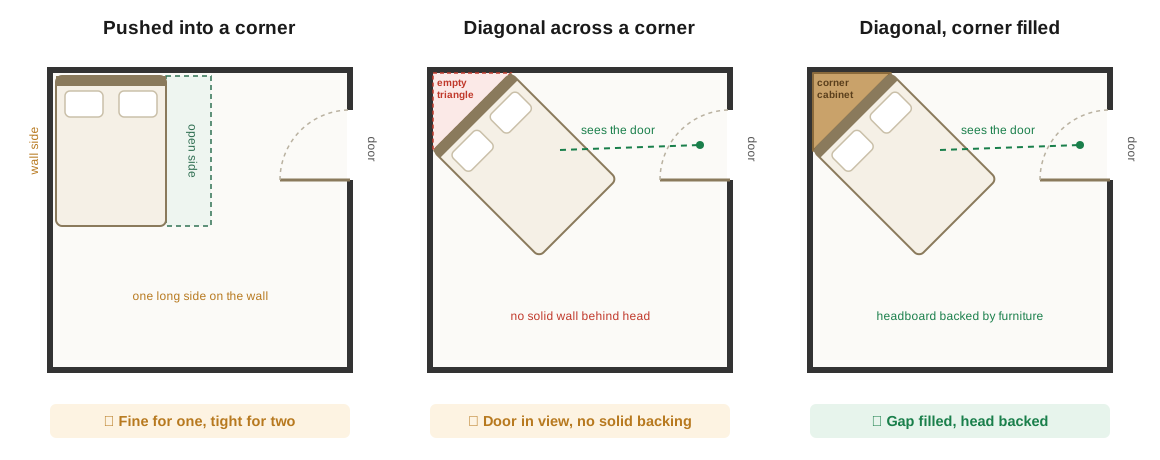
The same room and door. A bed pushed into the corner is fine for one sleeper; a diagonal bed sees the door but needs the empty triangle behind it filled, or a move to a straight solid wall.
Short answer: "bed in the corner" means two different things in feng shui. A bed pushed into a corner with one long side on the wall is usually fine for one sleeper, though couples do better with access on both sides. A bed set diagonally across a corner keeps the door in view but leaves an empty triangle behind the headboard. Fill that triangle with a solid headboard and tall furniture, or choose a straight solid wall instead.
Two different things people mean by a "corner bed"
People searching for a corner bed usually picture one of two layouts, and feng shui reads them differently.
- Pushed into the corner. The headboard sits on one wall and one long side runs along the adjoining wall. It is common in small bedrooms, kids' rooms, and studios because it frees the middle of the floor.
- Set diagonally across the corner. The bed is angled at roughly 45 degrees, with the headboard spanning the corner and the foot pointing into the room. People choose it to see the door or to break up a boxy room.
The first keeps a solid wall behind the head but limits access to one side. The second gains a view of the door but gives up the solid wall. Judge them separately.
Bed pushed into a corner, one side on the wall
The traditional preference here is about access, not the corner itself. Feng shui likes a bed you can approach from both sides, ideally with a bedside table on each, because it reads as balanced and gives each sleeper their own way in and out. A bed tucked against a side wall has only one open side, so traditional guidance often calls it less settled.
For one person this matters little. The headboard is still on a solid wall, which matters more, and a single sleeper only needs one way out. Our small bedroom guide treats this as a reasonable trade-off when the room is tight, as long as the open side stays clear and the doors still open.
For two people the picture changes. The partner on the wall side has to climb over the other to get up at night, has no bedside surface, and is boxed in by the wall. If you share the bed, pulling it out so both sides are reachable is usually worth more than the floor space you save.
A few everyday details are worth checking:
- Making the bed. Tucking sheets on the wall side is awkward; a fitted sheet and a duvet help.
- Cleaning. Dust collects between mattress and wall, so pull the bed out now and then.
- Cold walls. An exterior wall can feel chilly in winter; a small gap helps.
- Getting up. The open side should face your route to the door, not a wardrobe or door swing.
Bed set diagonally across a corner
An angled bed does have one advantage. Set across a corner, it often faces into the room with the door in clear view, which is one of the three parts of the commanding position.
The concern is what sits behind the headboard. Because the headboard spans the corner, its two ends touch the walls but its middle does not. That leaves an empty triangle of floor directly behind your head. Feng shui wants the head of the bed backed by something solid, and practitioner guidance describes this triangle as missing support. So while you sleep, your head is backed by open air rather than a wall.
Practically, the triangle collects dust and hard-to-reach clutter, and an angled bed takes far more floor than the same bed against a wall. By our arithmetic, a Queen mattress (60 × 80 in, about 152 × 203 cm) set at 45 degrees with both headboard corners touching the walls reaches about 99 in (about 251 cm) along each wall, before adding a frame. In a small room that can swallow the walkway.
How to support a diagonal bed
If you love the angle and the room is big enough, keep it and give the headboard some backing:
- Choose a tall, solid headboard. No slats, no open frame. A solid or upholstered headboard is the first layer of support, the same fix used for a bed under a window.
- Fill the triangle with something tall and solid. A triangular corner cabinet, a bookcase, or a heavy folding screen closes the gap so the headboard rests against furniture instead of empty space.
- Anchor it. Any tall piece behind a bed should be fixed to the wall. The U.S. Consumer Product Safety Commission recommends anchoring furniture with drawers, doors, and shelves to prevent tip-overs. Keep heavy objects off shelves above the pillows.
- Keep the foot out of the door's line. Angling the bed can point the foot straight at the doorway. Check that the door sits off to one side of your view.
Treat this as an improvement, not a cure. A filled corner gives back much of the missing support, but it is still not the same as a solid wall.
The other option is simpler: turn the bed so the headboard sits flat on a solid wall where you can still see the door. In many rooms that gives you the view you wanted from the diagonal without the empty triangle. Our guide to feng shui bed placement walks through testing each wall.
Comparing the three options
| Option | Feng shui read | Daily use | Best for |
|---|---|---|---|
| Pushed into a corner | Head on a solid wall; only one side reachable | Saves floor; awkward to make and clean on the wall side | One sleeper in a small room |
| Diagonal, empty triangle | Door in view; no solid backing behind the head | Uses the most floor; triangle collects clutter | Better avoided or supported |
| Diagonal, triangle filled | Door in view; backing restored by furniture | Still uses a lot of floor; furniture must be anchored | Larger rooms where you want the angle |
| Straight solid wall | Head backed; door in view if the wall is chosen well | Simplest to furnish and clean | Most bedrooms |
Check the space before you decide
This planner checks for about 18 in (45 cm) of access on each bed side you use and about 24 in (60 cm) on the main route through the room. These are layout heuristics, not building-code or accessibility requirements. A bed pushed into a corner only needs that band on its open side; a shared bed needs it on both. Angled beds need the closest look, because their two foot corners reach toward the middle of the room and can cut across the route from the door to the wardrobe.
Measure the actual frame and the door swing. Our bedroom size guide shows how much room each mattress size needs with two sides and the foot clear.
A quick self-check
Stand where your pillow goes and ask: Is there a solid wall directly behind my head, or an empty corner? Can I see the door without my feet pointing straight at it? Does each person who sleeps here have a side they can get out of? If the answers are no, no, and no, try a different wall before buying furniture to patch the corner.
Common mistakes to avoid
- Treating both corner layouts as the same problem. One-side-on-the-wall is about access; diagonal is about backing. They need different fixes.
- Leaving the triangle empty and full of clutter. If you keep the angle, close the gap with something solid.
- Skipping the anchor. A tall unanchored cabinet behind a bed is a real safety risk.
- Expecting a sleep or health result. Moving the bed can make a room feel calmer and easier to use. It is not a treatment for anything medical.
Sources and scope
This guide reflects practitioner guidance that the head of the bed should rest against solid support and that both sides should be reachable, described in Feng Shui Space Planner and Law of Feng Shui, and the empty-triangle concern with diagonal beds discussed by Feng Shui Nexus. Queen mattress dimensions come from Saatva; the diagonal reach is our arithmetic. Furniture anchoring advice comes from the CPSC's Anchor It campaign. This is a Form-school idea about where the bed sits relative to the walls and door, not a compass or birth-date method. We separate tradition, everyday comfort, and safety, and we make no sleep, health, or luck claims about a bed in a corner.
Compare corner and wall options in your room
It is easier to decide when you can see the options side by side. Draw your bedroom in the free planner with the real door, windows, and bed size, then compare the corner, the diagonal, and each straight wall before moving anything.
Frequently Asked Questions
Is it bad feng shui to put a bed in the corner?
It depends on which corner arrangement you mean. A bed pushed into a corner with one long side on the wall is a common small-room compromise: feng shui prefers access on both sides, but for one sleeper it is usually fine. A bed set diagonally across a corner gives a view of the door but leaves an empty triangle behind the headboard, which is the bigger concern.
Is a bed diagonal in the corner good feng shui?
It is mixed. The angle usually puts the door in view, which matches the commanding position, but the headboard no longer rests on a solid wall. Traditional guidance treats the open triangle behind it as missing support. A solid headboard plus a tall cabinet or screen filling the triangle is the usual response; a straight solid wall is often simpler.
Can a couple sleep in a bed with one side against the wall?
They can, but it is the least comfortable version of the corner bed. Feng shui prefers a reachable side and a bedside table for each person, and in daily life the person on the wall side has to climb over the other to get up. If the room allows it, pull the bed out so both sides have about 18 in (45 cm) of access.
What should I put in the corner behind an angled bed?
Something tall and solid that closes the triangle: a corner cabinet, a bookcase, or a heavy folding screen. Anchor any tall furniture to the wall, keep heavy items off shelves above the pillows, and pair it with a solid headboard. It improves the backing; it does not turn the corner into a wall.
Is it bad feng shui if the bed is not against a wall?
Feng shui prefers the head of the bed against a solid wall, so a headboard floating in the room or angled away from the wall is considered unsupported. The sides of the bed do not need to touch a wall. If the head cannot reach a wall, a tall, solid headboard and a heavy piece of furniture behind it give back some of that support.