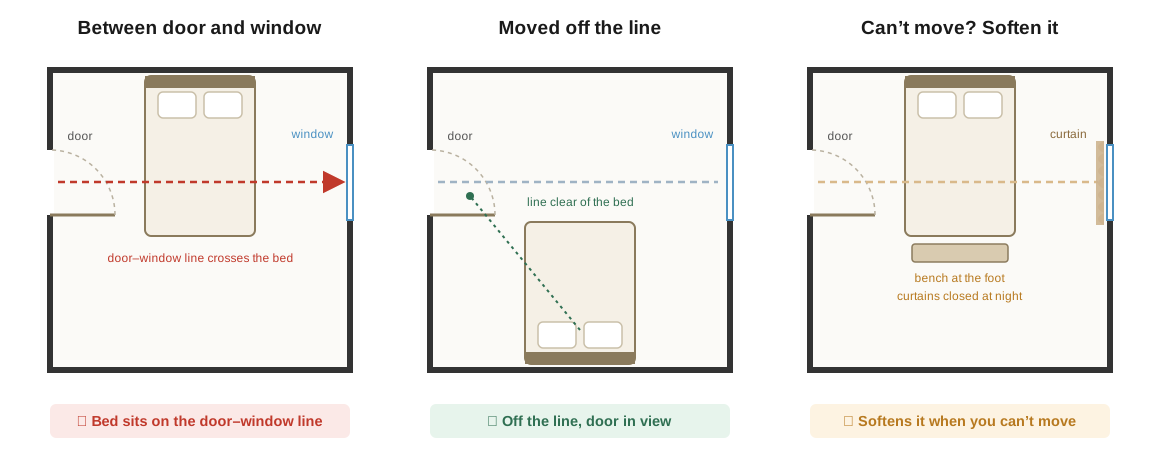
The same room, with the door and window on opposite walls. Moving the bed off the door-window line is the cleanest fix. When it has to stay, curtains closed at night and a bench at the foot soften the line.
Short answer: a bed facing a window is usually a mild feng shui concern. If the head is on a solid wall and you can see the door, a window at the foot mostly asks for good curtains. The arrangement worth changing is a bed sitting in the straight line between a door and a window; shift it off that line if you can, or soften it with curtains and a bench at the foot.
Facing, under, or in between: which one is yours?
"Bed and window" covers several arrangements, and feng shui treats them differently. Find yours first.
| Arrangement | What it means | Where to read |
|---|---|---|
| Feet toward a window | The window is on the wall opposite the head of the bed | This guide |
| Bed between door and window | Door and window on opposite walls, the line between them crossing the bed | This guide |
| Long side along a window | The window runs beside the bed | This guide (practical notes) |
| Headboard under or against a window | The window is directly behind your head | Bed under a window |
| Feet pointing straight at the door | The foot of the bed lines up with the doorway | Bed facing the door |
A headboard against the glass is the stronger concern and has its own guide. This page covers the window ahead of you or beside you.
What feng shui says about a bed facing a window
Feng shui looks at what surrounds you while you rest: a solid wall behind the head, the door in view, and a calm space in front of you. A large window straight ahead of the foot of the bed is described as an opening where energy moves in and out, so some practitioners prefer that your feet not point straight at it.
In everyday terms, a big pane of glass at the foot of the bed can feel exposed, especially at night when the room is lit and the outside is dark. That is the whole concern, and many practitioners treat it as minor once the head is supported and the door is visible. Some sources attach luck, romance, or health claims to it; we do not. It is a long-standing preference about calm and exposure, not a rule about outcomes.
The practical side: light, glare, drafts and privacy
The practical side is often more useful, because you can check it in one evening:
- Morning light. An east-facing window opposite the bed sends early light toward your face. Some people like that; others want a dark room until the alarm.
- Street light and glare. A city window at the foot of the bed can frame streetlamps or sweep headlights across the ceiling.
- Drafts and temperature. Older windows bring cool air toward the bed; strong afternoon sun can warm it.
- Privacy. A ground-floor or overlooked window facing the bed is the clearest case for a lined curtain.
If the long side of the bed runs along a window, the same points apply: leave a small gap for drafts and condensation, and keep the curtains free to close. None of this means you must move the bed. It tells you which window treatment you need.
When the door and window line up across the bed
When the door and a window sit on opposite walls, the straight line between them works like a corridor: tradition describes energy entering at the door and rushing out through the window. A bed across that line sits in the middle of the flow, which feng shui considers unsettled for a place of rest. In practical terms, a door and window opposite each other create a draft path and a natural walking route, so the bed gets air movement, window light, and doorway activity all at once.
To check, stand in the doorway and look at the window. If the straight line from you to the glass passes over the mattress, the bed is on the line. If it passes beside the bed or beyond its foot, you are already clear, even with the door and window on opposite walls.
The fix is usually a shift, not a full rearrangement. Move the bed so the door-window line passes beside it or past the foot, not over your body. Keep the head on a solid wall and the door in view, which is the commanding position. If the shift would leave your feet pointing straight out the door, that is a separate concern covered in our guide to a bed facing the door.
Should your bed face the door or the window?
Ideally neither straight on. The preferred placement puts the head against a solid wall, the door visible on the diagonal from your pillow, and the window off to one side where it lights the room without sitting in front of or behind you.
Real rooms rarely offer that, so here is the priority order we use. Avoid the foot of the bed pointing straight at the door first; it is the stronger and more widely shared concern. Avoid the headboard under a window next. A window at the foot of the bed comes after both, because it is the milder condition and curtains handle most of it. If your only choice is between feet toward the door and feet toward the window, choose the window.
Fixes, from easiest to biggest
Start with the lightest change that solves your actual problem:
- Curtains you close at night. Lined or blackout curtains give the window closure after dark and handle light, drafts, and privacy at once.
- Layered window treatments. A sheer or light blind by day plus heavier drapery at night keeps daylight without the exposed feeling at bedtime.
- A footboard or bench. A solid footboard, low bench, or storage chest at the foot of the bed adds a little closure between you and the window.
- A plant or folding screen. Set on the door-window line, it breaks the straight run without blocking either opening.
- Shift the bed. Sliding it along its wall, or turning the head to an adjacent solid wall, takes it off the door-window line entirely.
| Situation | Do this | What it does not change |
|---|---|---|
| Window at the foot, door in view | Lined curtains closed at night | The window is still opposite you, which is usually fine |
| Bright mornings or street light | Blackout lining behind a sheer or blind | Helps light, not the layout |
| Door and window line up across the bed | Shift the bed off the line | Nothing; this resolves it |
| Bed must stay on the line | Curtains plus a bench, footboard, or plant | The line still crosses the room |
Safety and daily use come first
Window fixes should never make the room harder to use or less safe. In many homes a bedroom window doubles as an emergency exit, so do not block it with tall furniture or fixed panels. A screen or plant should never narrow the walkway or stop the door from opening fully. In children's rooms, choose cordless blinds or keep cords out of reach, and keep curtains away from heaters and lamps. Daylight and fresh air are worth keeping: the curtains are for night, not for sealing the window.
A quick self-check
Lie in bed and ask three things: Is the window ahead of my feet, behind my head, or beside me? Do the door and window line up with the bed between them? Do I wake to light, glare, drafts, or a view into the room? A window ahead with the door in view needs curtains. A door-window line across the bed is worth a shift. A window behind the head belongs to the bed under a window guide.
Common mistakes to avoid
- Treating every window near the bed as a problem. A window at the foot or to the side is usually fine. The stronger concerns are the head under a window and the door line.
- Moving the bed into a worse spot. Do not trade a window at the foot for feet pointing straight at the door or a head with no solid wall behind it.
- Blocking the window to "fix" it. Furniture in front of the glass costs daylight, ventilation, and possibly an exit route.
- Expecting a sleep or luck result. Curtains and a better position can make the room feel calmer. They carry no promise about outcomes.
Sources and scope
This guide reflects common feng shui practice on beds and windows, described in references such as Lazy Loft, which advises against the foot of the bed pointing straight at a window and matches curtain weight to the outside environment, and LivingEtc, which prefers the head on a solid wall with the window set to the side or diagonal. For the door question, see Tom's Guide. It is a Form-school idea about where the bed sits relative to the walls, door, and windows, not a compass or birth-date method. We separate tradition, everyday comfort, and safety, and we make no sleep, health, relationship, or luck claims about a bed facing a window.
Test your wall options in your own room
Whether the door and window line up across your bed depends on your actual floor plan. Draw your bedroom in the free planner with the door, window, and walls in place. It checks the door line, a window behind the head, and the commanding position, so you can compare walls and see where the window lands relative to the foot of the bed before you move anything.
Frequently Asked Questions
Is it bad feng shui to have your bed facing a window?
Usually it is a mild concern rather than a placement to fear. Feng shui prefers the foot of the bed to face something calm and settled, and a large window at the foot can feel open and bright. If the head is on a solid wall and the door is in view, a window at the foot is mostly a matter of managing light and privacy with good curtains.
Should your bed face the door or the window?
Ideally neither straight on. The preferred spot puts the head on a solid wall with the door visible on the diagonal and the window off to the side. If you must choose, avoid the foot of the bed pointing straight at the door first; a window at the foot is generally the milder condition and is easier to soften with curtains.
What if my bed is between the door and the window?
When the door and window sit on opposite walls and the straight line between them runs across the bed, feng shui describes energy moving through the room too quickly over where you sleep. Shift the bed so that line passes beside it, not over it. If you cannot, close curtains at night and add a bench, footboard, or plant to break the line, keeping the door and walkway clear.
Is a bed against a window bad feng shui?
It depends which part touches the window. A headboard against or under a window is the bigger concern, because the head loses solid support; see our guide to a bed under a window. A long side of the bed along a window wall is mainly practical: leave a small gap for drafts and condensation, and keep curtains free to close.
How do I fix a bed that faces a window?
Start with window treatments: lined or blackout curtains you close at night, with sheer or light blinds for the day. A footboard or a bench at the foot of the bed adds a sense of closure. If the door and window also line up across the bed, shifting the bed off that line is the most effective change.
Does sleeping facing a window affect sleep?
We make no sleep or health claims. The practical points are easy to check yourself: early light, street lights, headlights, glare, and drafts can all reach the bed from a window opposite it. Curtains and blinds handle most of that. The feng shui side is a traditional preference about calm and exposure, not a medical rule.