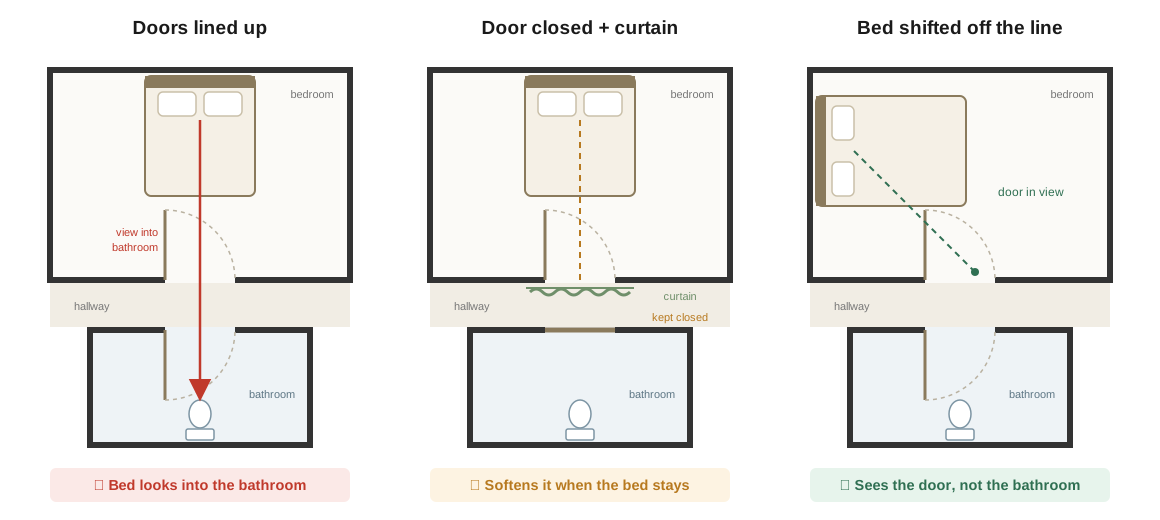
The same two doors across a hallway. Closing the bathroom door handles most of it; moving the bed off the line takes the bathroom out of view from the pillow.
Short answer: a bedroom door facing a bathroom door is a traditional dislike, not a hard rule. The reasons that hold up are practical: noise, light, smell, privacy, and seeing into the bathroom from bed. Keep the bathroom door closed first, then seal the gap, add a curtain if needed, and shift the bed so its foot does not point straight at either door.
What this layout looks like
Two versions come up again and again.
- Across a hallway. The bedroom door and the bathroom door sit directly opposite each other, so with both open you look from one room straight into the other.
- Inside a master suite. The en-suite door is lined up with the bedroom's main door, or with the foot of the bed, so the bathroom sits on the same line as the room's entry.
You will also see it searched as a bedroom door facing a toilet door. It is the same layout and the same advice. What you see from the bed matters more than the doors themselves. If the pillow looks through both doorways to the toilet, that is the version worth changing.
Why feng shui traditionally dislikes it
In feng shui, doors are where energy is said to move in and out of a room, and the bathroom is the room where water and waste leave the home. Two doors squared up across a short hallway are described as a direct channel between them, so the bathroom's draining quality is said to reach the bedroom, the room meant for rest.
How seriously should you take it? The idea is widely repeated in modern feng shui writing, but some practitioners openly note that it is a newer interpretation rather than a rule found in older texts, and most rate an everyday hallway version as mild. So treat it as a traditional preference you can respect, not a verdict on your home.
The practical reasons that hold up
Set the tradition aside and the layout still has real downsides. That is why so many people notice it:
- Noise. Flushing, running faucets, and an exhaust fan carry straight across a short hallway into the bedroom.
- Light. A bathroom light switched on at night shines directly through the opposite doorway.
- Smell and steam. Warm, damp air and odors drift across the shortest path, especially after a shower.
- Privacy. With both doors open, someone in the bedroom can see into the bathroom, and the other way around.
- The view from bed. Looking at a toilet from your pillow is the part people mind most, and it is purely about how the room feels.
Keep three things separate. Tradition is the door-to-door line. Comfort is noise, light, smell, and the view. Safety is doors that open fully and a clear path out of the room. Safety and daily use come first, and no remedy should trade them away.
Remedies, in a calm order
Start with the easiest step and stop when the room feels settled.
- Keep the bathroom door closed. This one habit removes most of the light, noise, smell, and view. Soft-close hinges or a light-duty door closer make it automatic and quiet. Choose a gentle closer that children and older family members can still open easily.
- Seal the gap. A door sweep or a brush strip along the bottom of the bathroom door cuts light and odor at the floor. Run the bathroom fan or open a window during showers so steam leaves the home rather than drifting into the bedroom.
- Add a curtain or screen. A curtain on the bedroom doorway, hung on the hallway side so it never catches the door, breaks the line when the bedroom door stays open. In an en-suite, a curtain on the bathroom doorway works the same way. Keep fabric away from heaters, and never let a screen block the path out of the room.
- Shift the bed. Place it so the foot of the bed does not point straight at the bedroom door or the bathroom door, and so the view from the pillow lands on the bedroom door, not into the bathroom. This is the same move as fixing a bed facing the door, and it often puts the bed in the commanding position at the same time.
- Soften the hallway. A runner rug and a low, warm night light in the hallway make the short gap between the doors feel like a passage rather than a straight shot, and help with nighttime trips without switching on the bright bathroom light.
| Fix | What it helps | What it does not change |
|---|---|---|
| Bathroom door kept closed | Light, noise, smell, view | The doors still line up |
| Door sweep and fan | Light at the gap, steam, odor | Sound through the door itself |
| Curtain or screen | The view down the line | Must stay clear of the door swing and exit path |
| Bed shifted | The view from the pillow, foot-to-door line | The doors still line up |
| Rug and night light | How the hallway feels at night | Nothing about the bathroom itself |
None of these change where the doors are, and that is fine. They take away the practical problems, and those are what most people feel.
Two doors in a bedroom: en-suite plus hallway
A master bedroom with its own bathroom usually has two doors: the main door to the hallway and the en-suite door. The bed has to work with both.
- Headboard on a solid wall where you can see the main bedroom door from the pillow.
- Foot of the bed not pointing straight at either door. A bed counts as facing a door when its foot points straight at that door, and the en-suite door counts as much as the main one.
- Avoid the wall shared with the shower or toilet if you have a choice, mainly so pipes and the fan are not right behind your head.
- Keep both door swings and the route between them clear, especially the path from the bed to the main door.
If the only workable wall leaves the en-suite door in view from the side, that is a reasonable result. Close that door at night and you have solved most of it. Watch for a mirror on the back of the bathroom door too: when that door stands open it can face the bed. Most traditions agree to avoid that reflection, and our guide to a mirror facing the door covers it.
Common mistakes to avoid
- Blocking the exit to fix the line. A screen, shelf, or heavy curtain must never narrow the way out or stop a door from opening fully.
- Making the bathroom door hard to open. A strong closer or a stiff latch is a nuisance at night and a problem for children or anyone unsteady on their feet.
- Hanging a mirror on the bathroom door as a cure. It can end up reflecting the bed. Closing the door does the job without that risk.
- Treating it as a reason to fear the room. This is a mild traditional preference plus a few comfort points. It does not predict anything about health, money, or relationships.
Sources and scope
This guide draws on practitioner writing that discusses this exact layout, such as Master Sean Chan on a bedroom door facing a bathroom door and on an en-suite door facing the bed, which also note the idea is a modern reading rather than a classical rule, together with bed-and-door consensus summarized by Tom's Guide. The ventilation advice follows the US EPA guide to moisture in the home. We keep tradition, everyday comfort, and safety separate, and we make no health, sleep, luck, or relationship claims about where a door or a bed sits.
Check the line in your own room
Whether the bed actually looks into the bathroom depends on your real measurements. Draw your bedroom in the free planner with both doors and the bed in place, try the bed on each solid wall, and compare the options. For the bigger picture, our feng shui bedroom layout guide walks through the bed, doors, and windows together.
Frequently Asked Questions
Is a bedroom door facing a bathroom door bad feng shui?
It is a common traditional dislike, not a firm rule. Feng shui treats the bathroom as the room where water drains away, and two doors squared up across a hallway are said to link that room straight to the bedroom. The concerns that clearly hold up are practical: noise, light, smell, humidity, privacy, and a view into the bathroom from the bed. Most of them are solved by keeping the bathroom door closed.
Is a bedroom door facing a toilet door any different?
No. People use bathroom door and toilet door for the same layout, and the advice is the same. The case people mind most is when the toilet itself is visible from the bed through both open doorways. Closing the bathroom door, or shifting the bed so the pillow no longer looks down that line, takes care of it.
What is the simplest remedy for a bedroom door facing a toilet door?
Keep the bathroom door closed. Soft-close hinges or a gentle door closer make that automatic and quiet, and a door sweep cuts light and smell at the gap. If the line still bothers you, hang a curtain on the bedroom doorway or shift the bed so the foot does not point straight at either door. Check that every door still opens fully and the path out stays clear.
Where should the bed go in a master bedroom with an en-suite door and a hallway door?
Put the headboard on a solid wall where you can see the main bedroom door from the pillow, with the foot of the bed not pointing straight at either door. Prefer a wall that does not back onto the shower or toilet if you have the choice, mostly for quiet. Keep both door swings and the walking route between them clear.
Should I hang a mirror on the bathroom door as a cure?
It is a remedy some sources suggest, but we do not recommend it as a first step. A mirror on a door that faces the bedroom can end up reflecting the bed, which is the mirror placement most traditions agree to avoid. Closing the door, a curtain, or moving the bed solve the same problem without adding a reflection.
Can a bedroom door facing a bathroom door affect health or luck?
We make no health, luck, or relationship claims. Some feng shui writing links this layout to outcomes, but the parts that hold up are everyday comfort: steam, smell, noise, and nighttime light reaching the bedroom. Treat the fixes as ways to make the room quieter and more private.