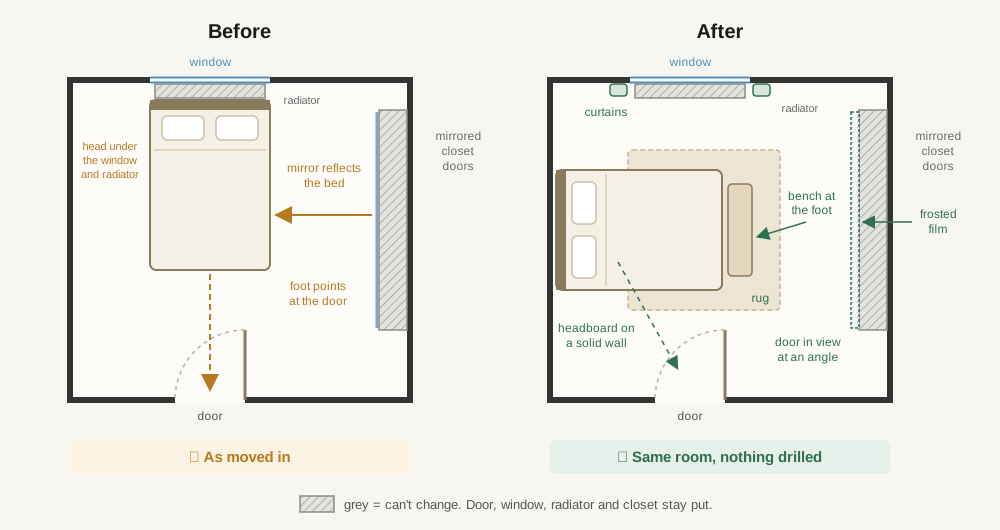
One rented bedroom, before and after. The grey items stay where the landlord put them. Only the bed, the bench, the rug, the curtains and a sheet of film changed.
Short answer: feng shui in a rental bedroom starts with the bed. Put the headboard on a solid wall where you can see the door at an angle, with the foot not pointing straight out of it. Then work around the fixed things you can't change: a bench at the foot if the bed faces the door, a solid headboard and curtains under a window, removable film on mirrored closet doors. Check your lease before painting or drilling.
What a renter can and can't change
Feng shui is a Chinese tradition about how buildings and rooms are arranged. We treat it as a cultural practice, not a science. Most bedroom feng shui advice assumes you can repaint, rehang the door or knock out a closet. Renters usually can't, and that's fine, because the advice that matters most is about furniture.
Things you usually can't change in a rented bedroom:
- the door, its position and the way it swings
- windows and window frames
- built-in closets, including mirrored sliding doors
- radiators, wall heaters and the AC unit
- outlets, light fixtures, ceiling fans and beams
- wall color, if the lease says no painting
Things you usually can change:
- where the bed and every other piece of furniture sits
- rugs, curtains, bedding and other textiles
- lamps, plants and art on removable hooks
- freestanding pieces like a headboard, screen or bookcase
Before you paint, drill, swap a light fixture or stick film on glass, read your lease or ask your landlord. We can't give legal advice, and this post assumes you'll leave the walls as you found them.
Start with the bed
The bed is the one big thing you control, so place it before you buy anything. Feng shui uses the commanding position for this. Practitioner Anjie Cho wants you to see the door from bed without lying straight in line with it, and she calls a spot diagonal from the door the best one. She also wants a solid wall behind the bed.
So, in order:
- The headboard is on a solid wall, not under a window.
- You can see the door from bed, ideally at an angle.
- The foot of the bed doesn't point straight out the door.
Try every wall before you settle. In a small room one of the three often has to give, and the fixes below cover each case.
Fixes for the things you can't move
When the bed has to face the door
Tradition dislikes a bed whose foot points straight out the door. Anjie Cho calls it the coffin position. If no other wall works, the common workaround is to put something solid between the foot of the bed and the door: a footboard, an upholstered bench or a storage trunk. A rug under the lower half of the bed helps mark the boundary too. All of these move out with you. Our guide to the bed facing the door goes through the other options.
Practically, keep the door's swing clear. A trunk the door hits every time is worse than no trunk.
When the only wall is under a window
In some rentals the window wall is the only one long enough for the bed. Anjie Cho advises against a window behind the bed, and if you can't avoid it, she says to use a solid headboard. Hunker's bedroom guide makes the same point a different way: the bed shouldn't go against an uncovered window.
For renters, that means a solid upholstered headboard that stands on its own or bolts to the bed frame, plus curtains you can close at night. A tension rod or the landlord's existing rod saves drilling. If a radiator sits under the window, as in the diagram, read the radiator note below too. Our post on the bed under a window covers more of this, including drafts and cold glass.
When there is no solid wall for the headboard
Sometimes the wall that would work has a radiator on it, or the bed floats in an open studio. The usual feng shui fallback is to give the bed something solid behind it. A freestanding headboard is the simplest choice. A low bookcase or console right behind the bed also works and gives you a place for a lamp. Our feng shui headboard guide covers shapes and materials.
Keep that furniture low. The U.S. Consumer Product Safety Commission's Anchor It campaign recommends anchoring furniture with drawers, doors and shelves to the wall to prevent tip-overs, and anchoring a tall bookcase means a small screw hole. Ask your landlord first. The Anchor It site points out that anchor holes are easy to fill when you move out.
Mirrored closet doors facing the bed
Mirrored sliding closet doors are common in rentals, and they are often right beside or across from the bed. Feng shui tradition prefers that you can't see yourself in a mirror while you're in bed, and Hunker's bedroom guide puts it the same way.
LoveToKnow's guide to covering mirrored closet doors says a fix in a rental should come off without damage. It calls vinyl window film the most forgiving option. Frosted film blurs the reflection and still lets light bounce around. Curtains are the other choice: a rod above the closet, or a tension rod inside the frame, lets you close them at night. The same guide warns that frosted glass paint is hard to remove, so skip it in a rental. Our bedroom mirror guide covers other mirrors in the room.
A beam or ceiling fan over the bed
You can't remove a beam or a ceiling fan, but you can move the bed out from under it. Tradition prefers nothing heavy directly over the sleeper, especially across the body. Often turning the bed 90 degrees or sliding it along the wall is enough. Our post on the beam over the bed shows which beams matter and which ones don't.
If the bed has to stay, a fabric canopy on a freestanding frame is the soft option some people use. Keep any fabric well away from light fixtures and fan blades.
A bathroom door facing the bed
Some en-suite bathrooms open straight toward the bed, or share a wall with the headboard. The common feng shui advice is simple: keep the bathroom door closed, especially at night. If the door won't stay shut or there isn't one, a curtain over the doorway does a similar job. Shifting the bed so it doesn't look straight into the bathroom is better still. Our post on the bedroom door facing a bathroom door covers both cases.
The practical side is ventilation. Run the fan or open the window after a shower so the moisture doesn't drift into the bedroom.
An AC unit or radiator at the head of the bed
Feng shui says little about this one, but comfort does. Cold air blowing on your face all night, or a radiator baking the headboard, is a reason to move the bed or turn it. If you can't move it, angle the AC vanes away from the bed.
Radiators also have a safety rule. The U.S. Fire Administration advises keeping anything that can burn at least 3 feet from heat sources, radiators included. That covers bedding, the headboard and curtains. The bed in the "Before" plan, pushed against the radiator, is a safety problem as well as a feng shui one. Pull curtains to the sides of a radiator rather than letting them hang over it.
Soft fixes you can take with you
Once the bed is set, the rest is mostly things that come with you when you move:
- Rugs: one under the bed softens a hard floor and marks the sleeping area.
- Curtains: tension rods or the existing rod, in a fabric heavy enough to close out streetlight.
- Lamps: a lamp on each side of the bed if you share it, so nobody depends on the overhead light.
- Plants: pick ones that suit your light, and check pet safety.
- Textiles: bedding, throws and cushions are the easiest way to bring in color without paint.
- Art: use removable hooks rated for the weight, and keep heavy frames and shelves off the wall above the bed.
Clearing out what you don't use helps more than buying anything new. Our post on bedroom clutter covers under-bed storage and closets.
Shared rooms, studios and small rentals
Studios
In a studio, the bed shares one room with the kitchen, the desk and the front door. The usual feng shui approach is to put the bed toward the back, out of line with the front door, and to separate it with a screen, curtain or open bookcase. Our feng shui apartment guide has more on zoning a studio.
Shared and small rooms
If you share a bedroom, each person ideally gets their own side of the bed with a nightstand and lamp, which can mean pulling the bed off a side wall. In a very small room, the bed may need to touch a wall. Our guide to the small bedroom goes through which rules to keep when everything won't fit.
Moving out
Every fix in this post either comes with you or comes off cleanly. Furniture, rugs, lamps and tension-rod curtains pack up like anything else. Window film peels off, and removable hooks come off if you follow the package instructions. If you anchored a bookcase with the landlord's OK, fill the hole before you hand back the keys.
Renter's feng shui checklist
- The lease is checked before any painting, drilling or film on glass.
- The headboard is on a solid wall, or a freestanding headboard or low bookcase stands behind it.
- You can see the door from bed, at an angle if possible.
- The foot of the bed doesn't point straight out the door, or a bench, trunk or footboard sits there.
- A bed under a window has a solid headboard and curtains you can close.
- You can't see yourself in a mirror from bed. Mirrored closet doors are covered with film or curtains.
- The bed is out from under beams and ceiling fans.
- The bathroom door is closed at night.
- The bed and bedding sit at least 3 feet from the radiator, and curtains don't hang over it.
- Heavy items stay off the wall above the bed.
Plan around the fixed things in the planner
Moving a bed to test a layout is hard work, so try it on a drawing first in our free 2D planner. You draw the room with its doors and windows, then add the fixed things you can't change: Built-in closet, Radiator, Air conditioner, Outlet, Beam, Pendant light, Ceiling fan, Column and Fixed cabinet. Then you place your own furniture from 12 types. The planner checks clearances, door swing and 8 bedroom placement rules, and it can suggest other bed positions that work around the fixed items. It does not read photos or floor plans. You draw the room yourself.
Sources and scope
The bed placement points (seeing the door at a diagonal, not in line with it) follow Anjie Cho's Q&A on bed direction, and the solid wall and headboard under a window follow her post on the best feng shui bed position. The uncovered window and mirror points come from Hunker's feng shui bedroom tips. The options for mirrored closet doors come from LoveToKnow's guide on how to cover mirrored closet doors. Tip-over advice comes from the CPSC's Anchor It campaign, and the 3-foot clearance from the U.S. Fire Administration's page on heating fire safety. Background on the tradition comes from Wikipedia's feng shui article. Nothing here is legal advice about your lease. We keep tradition, everyday comfort and safety separate, and make no claims about luck, money, love, health or sleep.
Frequently Asked Questions
What if I can't move the bed in my rental bedroom?
Work on what sits around the bed. If the foot points straight at the door, put a footboard, bench or trunk at the foot. If the head is under a window, use a solid upholstered headboard and curtains you can close. If there is no solid wall behind you, a freestanding headboard or a low bookcase can stand in for one. Feng shui tradition prefers moving the bed, but these are the usual fallbacks when the room won't allow it.
How do I deal with mirrored closet doors facing the bed in a rental?
Feng shui tradition prefers that you can't see yourself in a mirror from bed. In a rental, the usual options are removable vinyl or frosted window film on the glass, or curtains on a tension rod or a rod mounted above the closet so you can close them at night. Skip frosted glass paint, because it is hard to remove. Check with your landlord before putting anything on the glass.
Can I do feng shui in a rental without painting or drilling?
Yes. Most of bedroom feng shui is about where the bed and furniture go, and you can move furniture without touching the walls. Rugs, curtains on tension rods, lamps, plants, textiles and art on removable hooks cover most of the rest. Painting and drilling are optional, so check your lease or ask your landlord before doing either.
What should I change first in a rented bedroom?
Start with the bed. Feng shui tradition wants the headboard on a solid wall, the door in view from bed and the foot not pointing straight out the door. Once the bed is in the best spot the room allows, deal with the fixed features you can't change, then add the soft touches like rugs, lamps and curtains.
Can your planner help with a rented room?
Yes. In the free 2D planner you draw the room with its doors and windows and add the fixed things you can't change, such as a built-in closet, radiator, air conditioner, outlet, beam, pendant light, ceiling fan, column or fixed cabinet. Then you place your own furniture, and it checks clearances, door swing and 8 bedroom placement rules. It can also suggest other bed positions that work around those fixed items. It does not read photos or floor plans, so you draw the room yourself.