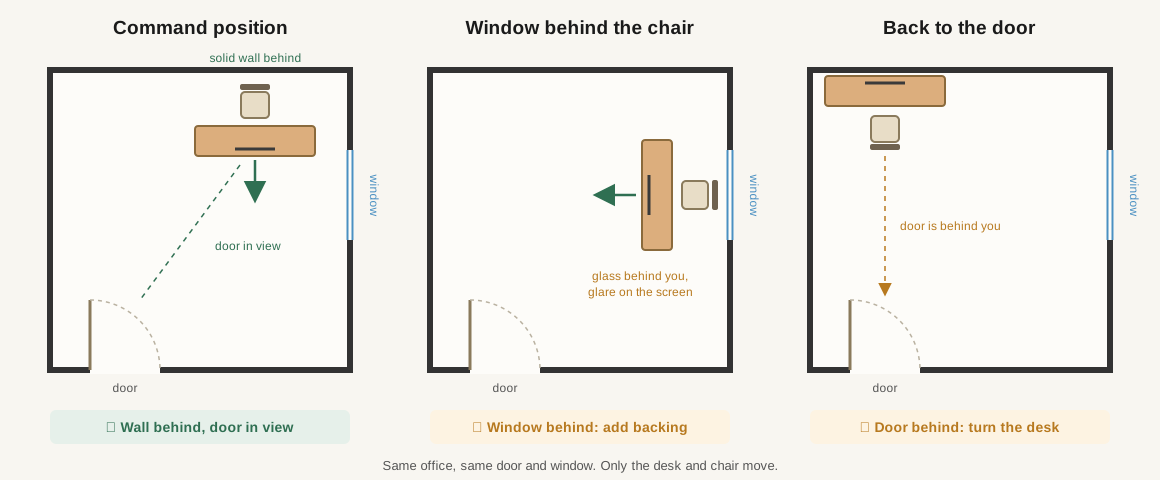
One office, one door, one window. Only the desk and chair move. The first layout keeps a wall behind you, the door in view and daylight from the side.
Short answer: in a feng shui home office, put the desk where you can see the door without sitting straight in line with it, with a solid wall behind your chair and the window off to one side. If the room won't allow that, keep as many of those three as you can and fix glare, cables and chair space by hand.
What a feng shui office layout is trying to do
Feng shui is a Chinese tradition about how buildings and rooms are arranged. It is a cultural practice, not a science, and we don't present it as one. For a home office, the traditional advice comes down to a few plain questions: what is behind you while you work, can you see who walks in, and is the room easy to move around in?
That is why most feng shui office advice sounds a lot like ordinary desk setup. Unlike a corporate office, a spare room or living room corner lets you choose where the desk goes, and that one choice decides most of the layout.
Put the desk in the commanding position
The commanding position is the core of feng shui office layout. You sit with a solid wall behind your chair, face into the room, and can see the door with a glance instead of turning around. It is the same idea feng shui uses for a bed, and our guide to the commanding position in feng shui explains where it comes from.
In practice that usually means floating the desk a little out from a wall, with your chair between the wall and the desk. The door ends up somewhere in front of you, slightly to one side. In the first diagram above, the chair backs onto the far wall and the door is visible across the room at an angle.
The tradition's reasoning is about support and awareness: a wall behind you feels settled, and nobody comes up behind you unseen. You don't need to believe in qi to find that seat comfortable for a long work session.
Desk and window: keep the window to the side
A window beside the desk is the easiest win in a home office. You get daylight on the work surface without staring into it or turning your back to the glass.
The two other options both come with trade-offs. Facing the window is pleasant, but it often leaves the door behind you, and bright sky behind a monitor makes the screen harder to read. A window behind the chair is what feng shui calls weak backing, since glass gives none of the support of a wall, and it can throw reflections onto your screen. OSHA's computer workstation guide reaches a similar layout for practical reasons: it suggests placing the monitor at right angles to windows and using blinds so daylight comes into the room but not straight into your field of view.
If the window wall is the only place the desk fits, a high-backed chair or low cabinet behind you helps, along with an adjustable shade. We cover these setups in feng shui desk next to a window.
When the desk has to face a wall
Plenty of home offices, like a narrow spare room or a closet office, only work with the desk pushed against a wall. That is common and workable.
Feng shui writers usually offer two small fixes. One is a small mirror on the desk or wall, angled so you can see the door behind you. The other is to make the wall in front of you worth looking at: a pin board, a calendar, or a picture you like instead of a blank surface. Both are traditions rather than rules, and the mirror needs care. Check it from your chair at the times you work, because a mirror that catches a window or a lamp can put a bright spot right next to your screen.
If you can, turn the desk so the door is at least at the edge of your vision. A quarter turn often does more than any accessory.
Don't sit straight in line with the door
Seeing the door is the goal, but sitting directly in front of it is not. Many feng shui guides advise against a desk lined up with the doorway. Tradition sees that line as carrying too much movement, and in everyday terms it is where people walk in and where noise and drafts come through. It can feel like working in a hallway.
The fix is usually small. Slide the desk so you see the door at an angle, as in the first diagram. The opposite mistake, a chair with its back to the door, is the third layout above, and turning the desk is the simplest fix.
Chair, clearance and cables
Treat the chair as part of the layout. Feng shui guides often recommend a chair with a solid, high back, which acts as backing when the wall behind you is far away or missing. OSHA's chair guidance comes at it from comfort: the backrest should support the natural curve of your spine.
Leave enough room behind the desk to push the chair back and stand up without hitting a wall, a shelf or a bed. Then check the walking route from the door to the desk and to any storage. Our planner uses about 24 in (60 cm) as a rule of thumb for a main route. That is a layout heuristic, not a building code, and a wider path is nicer if you have it.
Cables are where a tidy desk usually falls apart. A power strip mounted under the desk, a cable tray or a few ties keep cords off the floor where they can trip someone. Clear the space under the desk too; OSHA's desk guidance warns that clutter underneath can leave too little room for your legs. Feng shui treats clutter in a work area much like clutter elsewhere in the home, and our bedroom clutter guide covers the same habits for small rooms.
Lighting and screen glare
Good office lighting usually means two layers. Ambient light, from a ceiling fixture or daylight, lights the room. Task light, usually a desk lamp, lights the work surface. OSHA suggests positioning a desk lamp so its light does not reflect on the screen, choosing lamps with shades that keep light out of your line of sight, and avoiding very uneven lighting in your field of view.
Feng shui sources tend to favor natural light in an office, which fits the window-to-the-side layout: daylight from one side is easier to control than daylight in front or behind.
Plants and a calm palette
A plant or two is a common feng shui touch in an office, and many people simply like having something green near the desk. Pick a plant that suits your light and your watering habits, keep it off cables and outlets, and check pet safety if you have animals at home. Our post on feng shui plants in the bedroom goes through low-maintenance choices that also work on a desk or shelf.
For walls, soft neutrals or muted colors are the usual feng shui choice for a work room. Paint is a personal call, though lighter walls do bounce more daylight around a small room.
Small rooms, shared rooms and bedroom offices
In a small room the commanding position may not fit at all. Rank what matters: first make sure you are not sitting with your back to the door, then try to get a wall or solid furniture behind you, then sort out the window. Two out of three is a reasonable result in a tight room.
In a shared office, give the seat with the better door view to whoever works there more hours.
Many home offices are a desk in the bedroom. There the bed comes first in feng shui, and the desk works around it. Our guide to feng shui desk placement in a bedroom office walks through that arrangement.
Quick home office layout checklist
- You can see the door from your chair without turning around.
- The desk is not lined up straight with the doorway.
- A wall, cabinet or high-backed chair is behind you, not open space or bare glass.
- The window is beside the desk, or you have a shade to control light behind or in front of the screen.
- The monitor sits at roughly a right angle to the window.
- You can push the chair back and stand up without hitting anything.
- The route from the door to the desk is clear, about 24 in (60 cm) or more.
- Cables are off the floor and the space under the desk is clear.
- A desk lamp lights the work surface without reflecting on the screen.
- Any mirror is placed so it shows the door, not a window or lamp in your screen.
Sources and scope
The desk placement guidance here follows common feng shui advice for home offices, as described in Houzz's guide to feng shui for a home office and Living Spaces' feng shui home office tips. Background on feng shui as a tradition comes from Wikipedia's article on feng shui. The practical points about monitors, windows, lamps, chairs and the space under the desk come from OSHA's computer workstation eTool pages on monitors, the workstation environment, chairs and desks. The 24 in (60 cm) route figure is our planner's rule of thumb, not a code. We keep tradition, everyday comfort and safety separate, and we make no claims about productivity, career, money, health or luck.
Draw your office and place the desk
Our planner is built around bedrooms, but it can draw a room with its door, window and a desk. Draw the room in the free planner, place the desk and chair, and check by eye whether you can see the door, what sits behind your chair and where the window falls. The planner does not score desk feng shui, so use the checklist above for that part.
Frequently Asked Questions
Where should a desk go in a feng shui home office?
Feng shui calls the preferred spot the commanding position. You sit with a solid wall behind your chair, face into the room, and can see the door without sitting directly in line with it. A window works best beside the desk rather than behind you.
Is it bad feng shui to have a window behind your desk?
Tradition treats a window behind the chair as weak backing, since glass gives less sense of support than a wall. There is also a practical side: a bright window behind you can reflect on the screen. If it is the only option, add a solid high-backed chair or a low cabinet behind you and use a blind or shade.
Can my desk face a wall in a feng shui office?
Yes. Many home offices only fit a desk against a wall, and that is workable. Some feng shui writers suggest a small mirror that shows the door behind you, or a pin board or picture on the wall in front of you. Place any mirror so it does not catch a window or lamp in your screen.
Should my desk face the door directly?
Seeing the door is the goal, but many feng shui guides advise against sitting straight in line with the doorway. Shift the desk so the door is in view at an angle. That also keeps the chair out of the path of anyone coming in.
Does feng shui in a home office improve productivity or career luck?
We do not make that claim. Feng shui is a cultural tradition about how a space feels to sit in. A desk with a supported back, a view of the door and controlled glare can be more comfortable to work at, but results depend on you and your work, not on where the desk points.