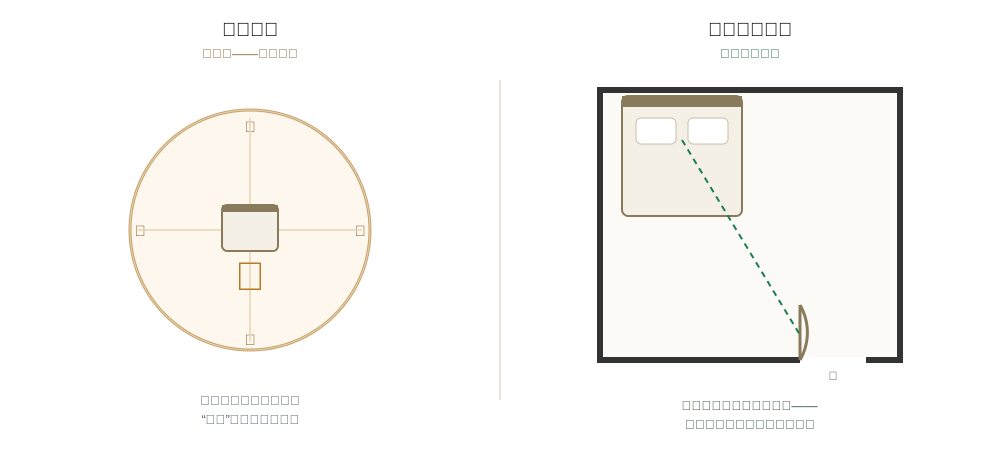
Two different questions. Compass direction is personal and needs a reading; placement geometry is the same for everyone and is what a room-layout tool can actually check.
Short answer: there is no single feng shui bed direction that is right for everyone. Direction systems are personal and compass-based, so a general page cannot honestly hand you one. What you can act on today is placement geometry — head on a solid wall, door in view, not in line with it.
Why "which way should my bed face" has no single answer
If you search for a feng shui bed direction, you usually get a confident chart telling you to sleep facing one direction. It is worth knowing why we do not give you that chart: feng shui actually contains two different traditions, and they answer two different questions.
- Compass-school direction asks which way the bed points relative to the compass. In many versions it also uses your birth date to work out a personal set of favorable directions. Because it depends on a compass reading of your room and on personal details, the "best" direction genuinely differs from one person to the next.
- Form-school placement asks where the bed sits relative to the walls, door, and windows. This does not change from person to person, and it carries the widest agreement across feng shui traditions.
A general article can only be honest about the second one. Any single direction it hands to every reader would not really be personal to anyone, which is why you see so much conflicting direction advice online.
The part everyone can act on: placement
The good news is that the most reliable, most agreed-on bedroom guidance is the part that needs no compass and no birth date. It is placement, and it comes down to the commanding position:
- The head of the bed is against a solid wall for support.
- You can see the door from your pillow.
- You are not in a straight line with the doorway.
Add the usual refinements — keep the head clear of a window, and out of a mirror or a dark screen's reflection — and you have handled the questions that actually change how a room feels to rest in. All of it is set out in our guide to feng shui bed placement, and none of it requires you to know which way is north.
If you still want to explore direction
Direction methods are a real tradition, and you are free to explore them. Just treat them as a separate, optional layer rather than the foundation, and go in with clear expectations:
- They need an accurate compass reading of your room, ideally away from metal and electronics that skew the needle.
- The personal versions need your birth information and a method for turning it into favorable directions.
- The results vary by person, so a friend's ideal direction tells you nothing about yours.
We keep these methods out of our planner on purpose. Our tool checks placement geometry, which applies to every room the same way; it does not read a compass, use your birth date, or predict fortune. That is a deliberate scope choice, not an oversight.
Common mistakes to avoid
- Treating a one-size direction chart as personal. If a chart gives everyone the same direction, it is not the personal compass method it appears to be.
- Skipping placement to chase a direction. Support, door view, and no straight-line alignment matter more and are easier to get right.
- Fighting your room to hit a compass heading. A worse-supported bed aimed at a "good" direction is usually a step backward.
- Expecting a direction to change your luck. We make no fortune, wealth, or health claims about which way a bed points.
Sources and scope
This guide reflects the standard distinction between Form-school placement and Compass-school direction, described in references such as Law of Feng Shui and Feng Shui Nexus. Our guidance and tool cover placement geometry only — where the bed sits relative to walls, door, and windows — not compass directions or personal birth-date methods, and we make no luck or fortune claims.
Start with placement in your own room
Skip the compass and start with what reliably helps. Draw your bedroom in the free planner with your walls, door, and window, and it will check the bed against placement priorities that apply to any room, in any direction.
常见问题
Which direction should my bed face in feng shui?
There is no single direction that is right for everyone. The direction-based methods in feng shui are personal: they depend on a compass reading of the room and, in some systems, your birth date. Because the answer changes from person to person, a general article cannot honestly tell you one direction. What everyone can act on is placement geometry: head on a solid wall, door in view, not in line with it.
Is feng shui bed direction the same as bed placement?
No. Bed direction is a Compass-school idea about which way the bed points relative to the compass, and it varies by person. Bed placement is a Form-school idea about where the bed sits relative to the walls, door, and windows, and it is the same for everyone. Placement has the widest agreement, so it is the more reliable place to start.
Do I need a compass and my birth date to place my bed well?
Not for the placement rules. The strongest, most widely shared bedroom guidance — the commanding position, head on a solid wall, not in line with the door — needs only the shape of your room. Compass and birth-date methods are a separate system you can explore later if you want, but they are optional and personal.
Why doesn't this site tell me my lucky sleeping direction?
Because an honest lucky direction depends on a compass reading and personal details we cannot know from a general page, and we do not make luck or fortune promises. We focus on geometry that we can check for any room and that has cross-school support, rather than giving a one-size direction that would not actually be personal to you.
What should I do instead of chasing a direction?
Start with placement. Put the head of the bed against a solid wall where you can see the door without lying in a straight line with it, and keep the head clear of windows and reflections. That single set of moves resolves most bedroom questions and does not require a compass or your birth date.